
Introduction
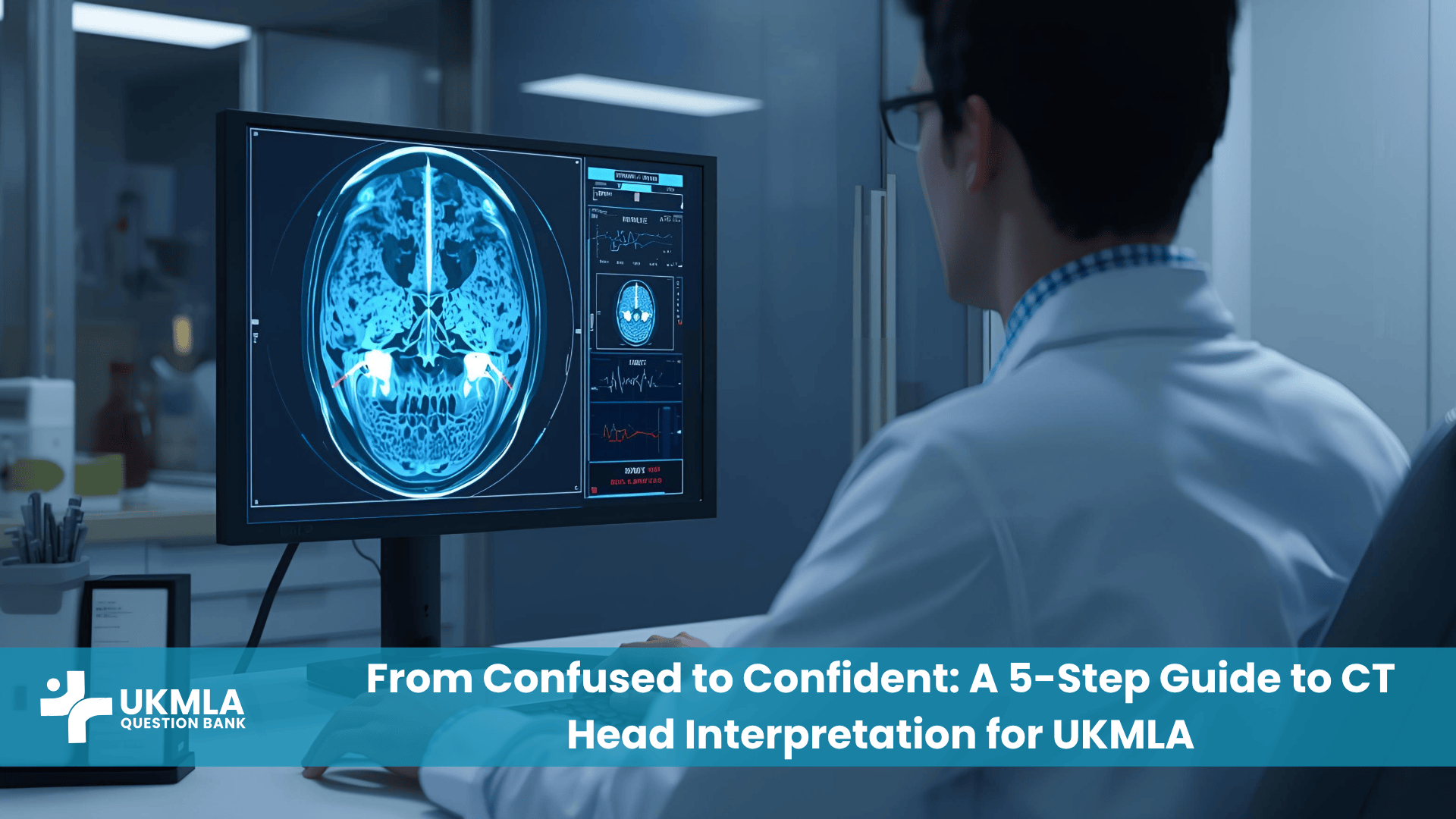
Mastering CT head interpretation for UKMLA candidates is not just an academic hurdle; it’s a fundamental pillar of safe clinical practice. As a junior doctor, you will be one of the first to review these critical scans, often in the middle of the night. Your ability to spot a life-threatening bleed or the subtle early signs of a stroke can directly alter a patient’s outcome.
This guide is designed to move you from a place of confusion and overwhelm to one of structured confidence. We will bypass the dense radiology-level physics and focus on a practical, systematic framework that you can apply reliably in both exam scenarios and on the wards. We’ll cover the high-yield pathologies, common pitfalls, and the exact 5-step system that ensures you miss nothing.
This article provides a deep dive into CT heads, but for a broader overview of all imaging modalities, you may also find our guide on Radiology Essentials for UKMLA helpful.
Table of Contents
ToggleKey Takeaways
A Systematic Approach is Non-Negotiable: Always use a structured review (like the 5-step method) to avoid missing subtle but critical findings.
Master the “Big 4” Bleeds: You must be able to confidently identify and differentiate Extradural (EDH), Subdural (SDH), Subarachnoid (SAH), and Intracerebral (ICH) haemorrhages.
Strokes are Subtle: In the hyperacute phase, ischaemic strokes are notoriously hard to spot. Learn to look for early signs like the “hyperdense MCA sign” and loss of grey-white differentiation.
“Windows” are Key: Always review the scan in both “brain” and “bone” windows. What’s invisible on one is obvious on the other (e.g., fractures).
Context is Everything: Always interpret the scan in the context of the patient’s clinical history (e.g., trauma vs. thunderclap headache vs. focal neurology).
Why CT Head Interpretation is a Non-Negotiable Skill for the UKMLA
The UKMLA is designed to test your “readiness for safe practice.” Your skill in CT head interpretation for UKMLA is a core part of this, and is woven through both parts of the exam. Few skills scream “safe doctor” louder than the ability to correctly interpret a STAT CT head scan.
The AKT Context: Spotting Critical Diagnoses in SBAs
In the Applied Knowledge Test (AKT), you won’t just be asked “What is this?” You’ll be given a clinical vignette—a 75-year-old on Warfarin who fell and is now confused—followed by a CT image. The single best answer will require you to integrate the history, identify the pathology (e.g., a crescent-shaped subdural haematoma), and select the correct immediate management step.
This is a test of applying knowledge, not just recalling facts. Your ability to analyse the scan is the crucial link between the patient’s story and the correct answer. This is a core component of interpreting clinical data for the UKMLA AKT, and a place where many candidates lose marks.
The CPSA Context: Justifying Investigations and Explaining Results
In the Clinical and Professional Skills Assessment (CPSA), your skills will be tested in a dynamic, real-world context. You may find yourself in stations requiring you to:
Justify the scan: You’ll need to articulate to an examiner (or a simulated senior colleague) why you are ordering a CT head, referencing specific criteria from NICE Guideline CG176 (Head injury: assessment and early management).
Explain findings: You may need to explain a finding to a patient or their relative in simple, empathetic language.
Formulate a plan: You will be expected to view a scan, identify the problem (e.g., hydrocephalus), and immediately articulate your management plan (e.g., “My primary concern is raised intracranial pressure. I would escalate immediately to the neurosurgical registrar on-call…”).
This skill is a core expectation outlined in the GMC’s “Outcomes for Graduates”, which states that new doctors must be able to “request and, where appropriate, interpret the results of… investigations, including… imaging.” This isn’t optional; it’s a day-one requirement.
Before You Start: Essential CT Physics and Terminology
To speak the language, you need to know the alphabet. For CT, this means understanding “density” and “windows.”
Understanding Hounsfield Units: Hyperdense, Isodense, and Hypodense
A CT scanner measures the density of different tissues and assigns them a value on the Hounsfield unit (HU) scale. For your purposes, all you need to know is how this translates to the image:
Hyperdense (Bright White): Tissues that strongly block x-rays.
Examples: Bone, acute blood (haemorrhage), contrast dye.
Hypodense (Dark/Black): Tissues that barely block x-rays.
Examples: Air (in sinuses), fat, cerebrospinal fluid (CSF), chronic blood (old haematoma).
Isodense (Grey): Tissues that are “in the middle.”
Example: Normal, healthy brain parenchyma.
Therefore, when we look for a “bleed,” we are looking for hyperdense (bright white) collections where they shouldn’t be. When we look for an “infarct” (stroke), we are looking for a hypodense (dark) area of dead brain tissue.
Windowing: Why “Brain” vs. “Bone” Windows Matter
A single CT scan contains far more data than a computer monitor can display at once. To solve this, the data is “windowed” to highlight specific tissues. The two windows you MUST check are:
Brain Window: This setting optimises the contrast for soft tissues. It allows you to differentiate the grey matter, white matter, CSF, and, crucially, any bleeds or strokes. On this setting, the bone is just a solid white-out.
Bone Window: This setting optimises for bone. The brain parenchyma becomes an indistinct grey mass, but you can now see the skull in exquisite detail. This is the only way to reliably spot a fracture.
Top Tip: Always toggle between the brain and bone windows. A depressed skull fracture, which is a neurosurgical emergency, will be completely invisible on the brain window.
The 5-Step Framework for Systematic CT Head Interpretation
The single biggest mistake a junior doctor can make is “satisfaction of search”—spotting one obvious finding (like a big bleed) and stopping, thereby missing the subtle fracture or second bleed.
A systematic approach is your antidote. The best one is a simple mnemonic: “Blood Can Be Very Bad.”
B = Blood
C = Cisterns (a specific place to look for blood)
B = Brain
V = Ventricles
B = Bone
Let’s adapt this into a 5-step process.
Step 1: Blood (Haemorrhage)
Start by looking for hyperdense (bright) collections. Look in the key spaces:
Extradural: Between the skull and the dura.
Subdural: Between the dura and the arachnoid.
Subarachnoid: In the cisterns and sulci (the “folds” of the brain).
Intracerebral/Parenchymal: Within the brain tissue itself.
Intraventricular: Inside the ventricles.
Step 2: Brain (Parenchyma, Grey-White Differentiation & Strokes)
Now, look at the brain tissue itself.
Grey-White Differentiation: Can you clearly see the border between the grey matter (outer) and white matter (inner)? If this border becomes “fuzzy” or is lost, it’s a sign of oedema, often from an early ischaemic stroke (the “insular ribbon sign”).
Hyperdense Vessels: Look at the path of the Middle Cerebral Artery (MCA). Does it look unusually bright? This is the “hyperdense MCA sign,” a crucial early warning of a large stroke.
Mass Effect: Is anything pushing the brain? Look at the midline. Is it shifted? Are the sulci (grooves) on one side “effaced” (squashed flat)?
Step 3: Ventricles (Size, Shape, and Hydrocephalus)
Look at the fluid-filled ventricles. They should be dark (hypodense), symmetrical, and a normal size.
Symmetry: Are they squashed or shifted by a mass?
Size: Are they abnormally large? This is hydrocephalus, which can be caused by a bleed or tumour blocking CSF flow. Look for “bulging” of the temporal horns of the lateral ventricles, an early sign.
Blood: Is there hyperdense blood inside the ventricles?
Step 4: Bone (Fractures, Sutures, and Sinuses)
Switch to the bone window. Systematically trace the entire skull, inside and out.
Fractures: Look for sharp, dark lines.
Sutures: Don’t mistake normal suture lines for fractures. Sutures are wiggly, symmetrical, and in predictable locations. Fractures are sharp, linear, and often associated with soft tissue swelling.
Sinuses: Check the mastoid air cells and paranasal sinuses. Are they filled with fluid (isodense) or blood (hyperdense) instead of air (black)? This is a key sign of a base of skull fracture.
Step 5: “All Else” (Soft Tissues, Orbits, and Final Review)
Finally, look “outside” the skull. Check the soft tissues for swelling or haematomas (a “boggy” scalp) which can be a clue to an underlying fracture. Look at the orbits. Do a final “zoom out” review of the entire scan.
This systematic review for CT head interpretation for UKMLA ensures you are thorough, efficient, and safe.
Table 1: 5-Step CT Head Checklist
| 5-Step CT Head Checklist |
|---|
| ✓ Blood: Check extradural, subdural, subarachnoid, and parenchymal spaces. |
| ✓ Brain: Check grey-white differentiation, look for hyperdense MCA sign, and assess for midline shift or mass effect. |
| ✓ Ventricles: Check for hydrocephalus (enlargement) or effacement (squashing). |
| ✓ Bone: Switch to bone window. Trace the skull for fractures. Check sinuses for air-fluid levels. |
| ✓ All Else: Check external soft tissues for swelling. |
High-Yield Pathologies for CT Head Interpretation for UKMLA
You must be able to instantly recognise the following pathologies.
Haemorrhage Deep Dive: Spotting the “Big 4”
The shape and location of the bleed are everything.
Extradural Haemorrhage (EDH): The “Lemon”
Appearance: A biconvex (lens-shaped) collection. Think “lemon.”
Location: Between the skull and the dura.
Mechanism: Almost always traumatic (e.g., a blow to the side of the head), causing a tear in the middle meningeal artery.
Key Feature: It does not cross suture lines because the dura is firmly attached at these points.
Clinical Pearl: This is the classic “lucid interval” patient—knocked out, wakes up and seems fine, then rapidly declines in consciousness as the arterial bleed expands. This is a life-threatening neurosurgical emergency.
Subdural Haemorrhage (SDH): The “Banana”
Appearance: A crescent-shaped collection that follows the curve of the inner skull. Think “banana.”
Location: Between the dura and the arachnoid.
Mechanism: Usually due to tearing of bridging veins. This is common in elderly patients or alcoholics (who have brain atrophy, stretching the veins) after a fall.
Key Feature: It can cross suture lines but will not cross the dural reflections (like the falx cerebri).
Clinical Pearl: Can be acute (bright white), subacute (isodense, very hard to see!), or chronic (hypodense/dark, as the blood breaks down).
Subarachnoid Haemorrhage (SAH): The “Star”
Appearance: Hyperdense blood in the cisterns and sulci. The classic appearance is the bright “star” of the basal cisterns.
Location: Between the arachnoid and pia mater (where the CSF lives).
Mechanism: Often from a ruptured berry aneurysm (“spontaneous”) or severe trauma.
Key Feature: The blood outlines the structures of the brain.
Clinical Pearl: The patient will describe the “worst headache of my life” or a “thunderclap headache.”
Intracerebral Haemorrhage (ICH): The “Parenchymal Bleed”
Appearance: A hyperdense collection of blood within the brain tissue itself, often surrounded by hypodense oedema (swelling).
Location: Anywhere in the parenchyma (basal ganglia, thalamus, pons, cerebellum).
Mechanism: Most commonly due to chronic hypertension causing rupture of small, deep arteries. Can also be from trauma, tumours, or amyloid angiopathy.
Clinical Pearl: Presents with sudden-onset, focal neurological deficits (e.g., one-sided weakness, slurred speech) that are often maximal at onset.
Table 2: Differentiating the “Big 4” Haemorrhages
| Haemorrhage Type | Shape | Typical Vessel | Crosses Sutures? | Typical Cause |
|---|---|---|---|---|
| Extradural (EDH) | Biconvex (Lemon) | Artery (Middle Meningeal) | ✗ No | Trauma (e.g., temporal bone fracture) |
| Subdural (SDH) | Crescent (Banana) | Vein (Bridging) | ✓ Yes | Trauma in elderly/atrophy |
| Subarachnoid (SAH) | Follows Cisterns (Star) | Artery (Aneurysm) | N/A (in subarachnoid space) | Ruptured Aneurysm (spontaneous) |
| Intracerebral (ICH) | Within Parenchyma | Artery (Lenticulostriate) | N/A (within brain) | Hypertension |
Ischaemic Stroke Deep Dive: From Subtle Signs to Established Infarct
Unlike a bleed (which is hyperdense), an acute ischaemic stroke (a blockage) is much harder to spot. In the first few hours (the “hyperacute” phase), the brain may look normal. Your job is to hunt for the subtle signs. For a full breakdown of stroke syndromes, see our guide to neurology essentials for the UKMLA.
The Hyperdense MCA Sign: The Earliest Clue
What it is: The clot itself, lodged in the Middle Cerebral Artery (MCA), is dense. This makes the MCA on the affected side appear brighter than the one on the normal side.
Why it matters: This is one of the earliest signs of a large vessel occlusion. It’s a time-critical finding that indicates the patient may be a candidate for thrombectomy.
Loss of Grey-White Matter Differentiation
What it is: As the brain tissue starts to die from lack of oxygen (cytotoxic oedema), it swells and loses its normal density. The crisp border between the outer grey matter and inner white matter becomes blurry and indistinct.
How to spot it: Compare the two hemispheres. Is one side “fuzzier” than the other?
The Insular Ribbon Sign
What it is: This is a specific example of the sign above. The insular cortex (or “insular ribbon”) is a part of the brain deep in the Sylvian fissure that is very sensitive to ischaemia.
How to spot it: Look for a “plump,” swollen, and indistinct insular ribbon compared to the healthy side.
After 12-24 hours, the stroke becomes “established,” and the dead tissue becomes clearly hypodense (dark) in a wedge-shape following an arterial territory. The UKMLA will test you on both the subtle early signs and the obvious late signs.
Putting It All Together: 3 UKMLA-Style Clinical Scenarios
Let’s apply the framework.
Case 1: The Confused Elderly Patient After a Fall
Vignette: An 82-year-old woman is brought in by her daughter. She has been “more confused than usual” for the past 3-4 days. Her daughter mentions she had a “minor slip” in her kitchen about a week ago but didn’t hit her head. Her GCS is 14 (E4 V4 M6).
Your 5-Step Review:
Blood: You see a crescent-shaped, isodense (grey) collection over the left hemisphere. It’s hard to see, but it’s there.
Brain: The left lateral ventricle is squashed, and there is a 4mm midline shift to the right.
Ventricles: As above, the left ventricle is effaced.
Bone: No fracture.
All Else: Normal.
Diagnosis: Subacute Subdural Haematoma (SDH) with mass effect. The “isodense” state makes it tricky to spot, which is why checking for secondary signs (like mass effect) is vital.
Action: Urgent neurosurgical referral.
Case 2: The Sudden “Thunderclap” Headache
Vignette: A 45-year-old man presents to A&E stating he was “fine one second, and the next it felt like I’d been hit in the back of the head with a baseball bat.” He is vomiting and finds the lights too bright.
Your 5-Step Review:
Blood: You see hyperdense (bright) signal in the basal cisterns (the “star”), the Sylvian fissures, and tracking up into the sulci.
Brain: No infarct. No mass effect yet.
Ventricles: Normal size, but you check the temporal horns, which look slightly “plump.”
Bone: No fracture.
All Else: Normal.
Diagnosis: Subarachnoid Haemorrhage (SAH).
Action: Urgent neurosurgical referral, start Nimodipine, manage blood pressure.
CPSA Sample Script: Presenting a Finding
“I have reviewed the non-contrast CT head for this patient. The brain window shows extensive hyperdense signal within the basal cisterns, Sylvian fissures, and interhemispheric fissure, which is consistent with an acute subarachnoid haemorrhage. There is no evidence of hydrocephalus or large territorial infarct at this stage. On the bone window, I see no skull fracture. My immediate plan is to contact the on-call neurosurgical registrar for urgent review and to discuss starting Nimodipine.”
Case 3: The Acute Onset Weakness and Slurred Speech
Vignette: A 68-year-old man with a history of hypertension and type 2 diabetes presents with a 1-hour history of acute-onset right-sided weakness and expressive dysphasia.
Your 5-Step Review:
Blood: No haemorrhage. (This is the first and most important step—it rules out a haemorrhagic stroke and “rules in” thrombolysis).
Brain: You look closely at the left MCA and see it appears hyperdense compared to the right. You also notice a subtle loss of the insular ribbon sign on the left.
Ventricles: Symmetrical.
Bone: No fracture.
All Else: Normal.
Diagnosis: Acute Ischaemic Stroke (L) MCA territory, with hyperdense MCA sign.
Action: Urgent stroke team call. This patient is in the thrombolysis window.
Common Pitfalls and How to Avoid Them
✗ Pitfall 1: Mistaking Sutures for Fractures
✓ How to Avoid: Sutures are wiggly, symmetrical (you’ll see them on both sides), and in predictable anatomic locations. Fractures are sharp, dark, linear, and often have overlying soft tissue swelling. Always check the bone window.
✗ Pitfall 2: Forgetting to Check the Sinuses
✓ How toAvoid: A patient with “panda eyes” may have a base of skull fracture. The CT head may not show the fracture line itself, but it will show an air-fluid level (blood) in the sphenoid or mastoid sinuses. This is an indirect sign of a severe injury.
✗ Pitfall 3: The “Satisfaction of Search” Error
✓ How to Avoid: You spot a large, obvious ICH. You feel great. You stop looking. You miss the second bleed or the fracture that caused it. Never stop your search. Complete the full 5-step systematic review, every single time, even if a finding is obvious.
Frequently Asked Questions (FAQ) about CT Head Interpretation
A non-contrast scan is extremely fast and is the gold standard for one critical question: is there blood? Acute blood (haemorrhage) is bright white and obvious. Contrast (which is also bright white) would obscure a bleed. We must rule out a bleed before giving thrombolysis for an ischaemic stroke.
Mass effect is the “pushing” of brain structures caused by an expanding lesion like a bleed or tumour. On a CT scan, you can identify this by looking for three key signs: a midline shift, where the falx cerebri is pushed away from the centre; ventricular effacement, which means the ventricle on the same side as the mass is compressed or “squashed”; and sulcal effacement, where the normal grooves, or sulci, on the surface of the brain are flattened and become indistinct.
Hydrocephalus is the enlargement of the ventricles due to a buildup of CSF. The most common cause after a bleed (like an SAH) is blood blocking the drainage pathways. Look for abnormally “plump” or dilated ventricles, especially the temporal horns, which often bulge first.
This is a key concept. In the first 0-6 hours (the hyperacute phase), the scan may be normal. The only signs might be the subtle “hyperdense MCA sign” or “loss of insular ribbon.” The classic dark (hypodense) wedge of dead tissue only becomes obvious after 12-24 hours.
They are often used interchangeably, but ‘CT head’ is the more precise term. ‘CT brain’ implies a focus only on the brain parenchyma. A ‘CT head’ correctly describes the full examination, which includes a systematic review of the brain, the ventricles, the blood vessels, the skull (bone windows), and the surrounding soft tissues, which is essential for a complete diagnosis.
Sometimes. Large tumours may be visible as an isodense or hypodense mass causing significant mass effect. However, many tumours (especially metastases) are only clearly visible after giving IV contrast (on a “CT head with contrast”).
These are strokes that occur in the “border zones” between two major arterial territories. They look like small, dark (hypodense) areas in a linear pattern. They are typically caused by a period of severe low blood pressure (hypotension) rather than a single clot.
In atrophy (common in old age or dementia), the brain tissue itself shrinks. On a CT, this looks like the opposite of mass effect: the sulci (grooves) appear much wider and more prominent, and the ventricles look larger, simply because there is less brain to fill the space.
After about 1-2 weeks, the blood in a haematoma breaks down and becomes “isodense”—the exact same grey as the brain parenchyma. This makes it almost invisible. You must look for secondary signs: is the midline shifted? Is one ventricle squashed? Is the grey-white junction pushed inwards?
These are the dural reflections—tough folds of dura that separate brain compartments. The falx cerebri is the vertical fold that separates the left and right hemispheres, which is why a subdural haematoma (which is under the dura) can cross sutures but cannot cross this midline structure. The tentorium cerebelli is the horizontal “tent” that separates the (upper) cerebrum from the (lower) cerebellum, and findings are often described as ‘supratentorial’ (above) or ‘infratentorial’ (below) it.
Conclusion
Your journey in mastering CT head interpretation for UKMLA exams and beyond is a marathon, not a sprint. This 5-step framework—Blood, Brain, Ventricles, Bone, All Else—is not just a tool for the exam; it is your professional safety net. It is the structure that will protect you and your patients when you are reviewing a scan at 3 AM.
Confidence comes from repetition. Every time you are on the wards, every time a patient gets a CT head, pull it up. Run through your 5-step system. Compare your findings to the formal radiology report. This active, real-world practice is what will cement this knowledge and make CT head interpretation for UKMLA second nature.
Your Next Steps
Bookmark Key Resources: Save the NICE CG176 head injury guidelines and review the criteria for when to scan a patient.
Practice on Real Scans: Use your hospital’s PACS system (with appropriate permissions) or online radiology libraries to review anonymised scans. Practice the 5-step system.
Review Related Topics: Solidify your knowledge by reviewing the fundamentals of neurology essentials and the key red flag symptoms (like thunderclap headache) that trigger these scans.
Simulate the CPSA: Next time you review a scan, practice saying your findings out loud in a clear, structured manner, just as you would in a CPSA station. This will build both your knowledge and your communication skills.