
Introduction
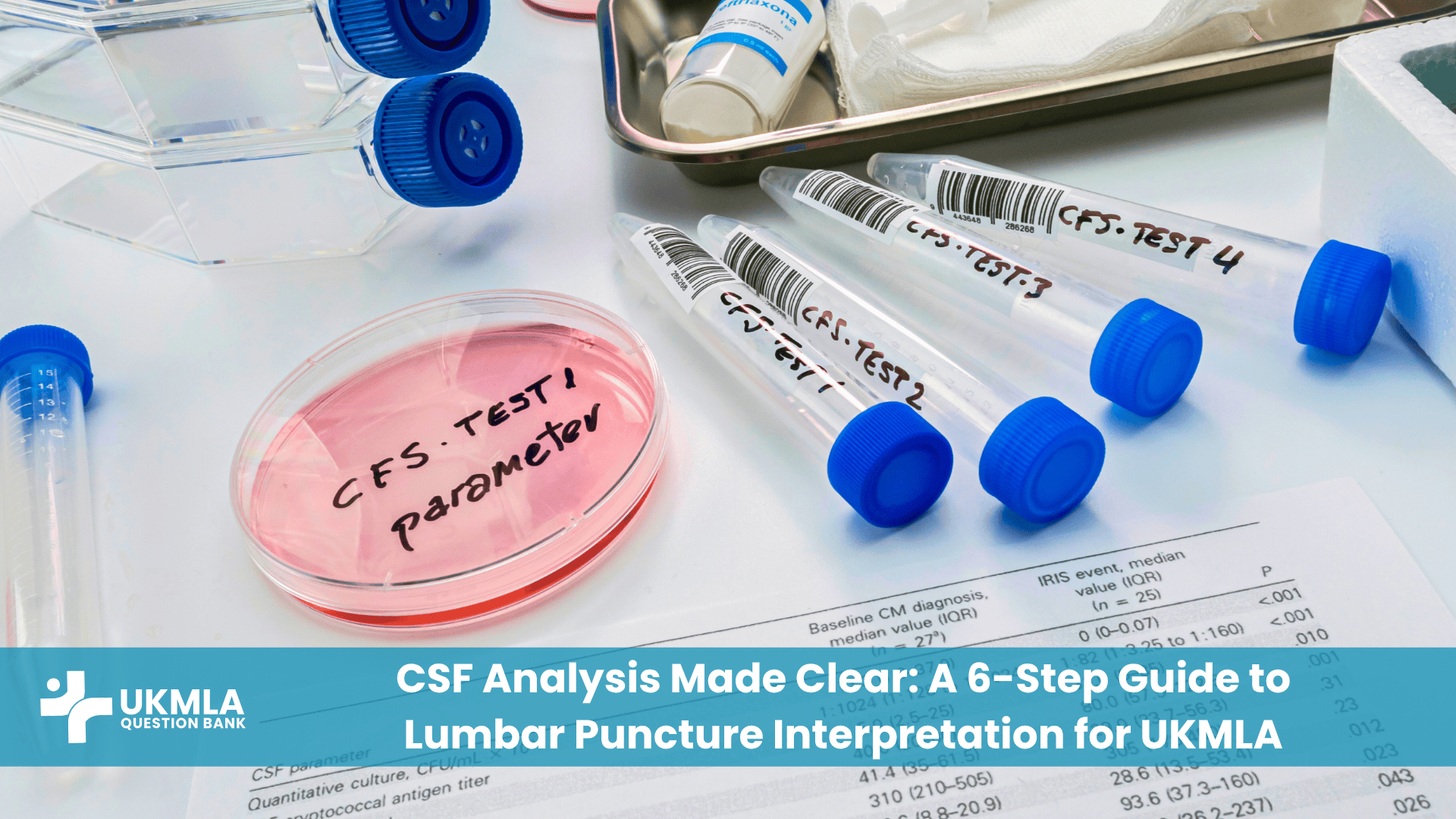
Mastering lumbar puncture interpretation UKMLA candidates need is a critical skill, particularly in neurology, infectious diseases, and emergency medicine. While performing the lumbar puncture (LP) procedure itself requires technical proficiency (covered in our Procedural Skills Guide), accurately analysing the cerebrospinal fluid (CSF) obtained is equally vital for reaching the correct diagnosis. CSF analysis provides a direct window into the central nervous system, helping to identify infections like meningitis, detect bleeding like subarachnoid haemorrhage (SAH), and diagnose inflammatory conditions like multiple sclerosis (MS).
This guide provides a clear, systematic 6-step approach to interpreting LP results. We’ll break down each component of the analysis, highlight the characteristic CSF patterns in high-yield conditions, discuss common pitfalls like interpreting traumatic taps, and help you integrate these findings into UKMLA-style clinical scenarios.
Table of Contents
ToggleKey Takeaways
Safety First: Always check for contraindications (raised ICP signs like papilloedema, focal neurology; significant coagulopathy; local skin infection) before performing an LP.
Systematic Interpretation: Use a 6-step approach (Pressure, Appearance, Cells, Glucose, Protein, Specific Tests) to analyse CSF results thoroughly and avoid missing crucial clues.
Meningitis Patterns: Learn the classic CSF patterns for bacterial (cloudy, high neutrophils, high protein, low glucose), viral (clear, high lymphocytes, normal/high protein, normal glucose), and TB meningitis (viscous, high lymphocytes, very high protein, low glucose).
Look for Xanthochromia: In suspected Subarachnoid Haemorrhage (SAH) with a negative CT head performed >6 hours after onset, xanthochromia (yellow CSF supernatant due to bilirubin) is a key diagnostic finding. Spectrophotometry is the gold standard for detection.
Context is Everything: Interpret CSF results alongside the patient’s clinical presentation (fever, headache, neurology), timing of LP relative to symptom onset, and other investigations (e.g., CT head, blood cultures, serum glucose).
Why Mastering Lumbar Puncture Interpretation UKMLA Requires
Interpreting CSF results is fundamental for diagnosing several neurological emergencies and common conditions frequently tested in the UKMLA.
The AKT Context: Diagnosing CNS Infections and SAH
In the Applied Knowledge Test (AKT), you will be presented with clinical scenarios accompanied by CSF results. You’ll need to interpret the pattern (e.g., high neutrophils, low glucose) to identify the likely diagnosis (bacterial meningitis) or recognise specific findings like xanthochromia pointing to SAH. Understanding these patterns is crucial for correctly answering questions on diagnosis and immediate management. This ties into your ability to Master Interpreting Clinical Data.
The CPSA Context: Performing the Procedure & Interpreting Results
The Clinical and Professional Skills Assessment (CPSA) might assess your understanding in stations involving:
Indications/Contraindications: Justifying why an LP is needed or explaining why it’s contraindicated.
Result Interpretation: Being given a set of CSF results and asked to interpret them and formulate a management plan.
Communication: Explaining the LP procedure to a patient or discussing the results and their implications (e.g., confirming meningitis).
Indications & Contraindications for Lumbar Puncture
Knowing when (and when not) to perform an LP is critical for patient safety.
Common Indications:
Suspected CNS Infection: Meningitis, encephalitis (viral, bacterial, fungal, TB). This is the most common urgent indication.
Suspected Subarachnoid Haemorrhage (SAH): When CT head is negative or equivocal, especially if performed >6 hours after symptom onset.
Diagnosis of Inflammatory Conditions: Multiple Sclerosis (MS), Guillain-Barré Syndrome (GBS).
Diagnosis of Malignancy: CNS lymphoma, carcinomatous meningitis (CSF cytology).
Therapeutic: Reducing CSF pressure (e.g., idiopathic intracranial hypertension), intrathecal drug administration.
Key Contraindications:
Signs of Raised Intracranial Pressure (ICP): Papilloedema, focal neurological signs, significantly reduced GCS (<12), seizures. Risk of brain herniation (coning). Perform CT head first if suspected.
Significant Coagulopathy: Low platelets (<50 x10^9/L often cited, check local policy), high INR (>1.5), anticoagulation. Risk of spinal haematoma.
Infection at the LP Site: Risk of introducing infection into CNS.
Shock/Haemodynamic Instability: Stabilise the patient first.
The 6-Step Framework for Systematic CSF Interpretation
Always analyse CSF results methodically:
Step 1: Opening Pressure
Measured: During the LP procedure using a manometer (patient lying in lateral decubitus position, legs relaxed).
Normal Range: Typically 10-20 cmH₂O in adults.
Interpretation:
✓ High Pressure (>25 cmH₂O): Suggests raised ICP. Common in bacterial, fungal, or TB meningitis; can also occur with tumours or idiopathic intracranial hypertension.
✓ Low Pressure (<10 cmH₂O): Can occur with CSF leak (e.g., post-LP headache) or spinal block.
Step 2: Appearance
Normal: Clear and colourless (“like water”).
Abnormal Appearance:
✓ Cloudy/Turbid: Indicates high cell count (WBCs/pus) or microorganisms – strongly suggests bacterial meningitis.
✓ Bloodstained: Can be due to a traumatic tap (blood clears in sequential tubes) or true SAH (blood doesn’t clear). Needs centrifugation.
✓ Xanthochromic (Yellow): Yellowish supernatant after centrifugation. Indicates previous presence of blood breakdown products (bilirubin). Key finding for SAH if LP performed >12 hours after onset. Can also occur with very high protein or jaundice.
Step 3: Cell Count & Differential (Microscopy)
White Blood Cell (WBC) Count:
Normal: <5 cells/mm³.
Pleocytosis (High WBC): Indicates inflammation/infection.
Differential is Key:
Neutrophil Predominance: Strongly suggests bacterial meningitis.
Lymphocyte Predominance: Suggests viral meningitis/encephalitis, TB meningitis, fungal meningitis, MS, or CNS malignancy.
Red Blood Cell (RBC) Count:
Normal: 0 cells/mm³.
High RBCs: Due to traumatic tap or SAH. Compare tube 1 vs. tube 3/4 counts; a significant drop suggests traumatic tap. Persistently high counts suggest SAH. Look for crenated RBCs and correlate with appearance (xanthochromia).
Step 4: Glucose Level (Compared to Blood Glucose)
Measurement: CSF glucose level. Crucially, must be compared with a simultaneous blood glucose level.
Normal: CSF glucose is typically ~60% of blood glucose (CSF:Serum ratio >0.6).
Interpretation:
✓ Low CSF Glucose (<50% of blood glucose): Bacterial meningitis (bacteria consume glucose), TB meningitis, fungal meningitis, malignancy.
✓ Normal CSF Glucose: Usually seen in viral meningitis.
Step 5: Protein Level
Normal Range: Typically 0.15 – 0.45 g/L (check local lab).
Interpretation:
✓ High Protein (>0.5 g/L): Indicates inflammation or infection disrupting the blood-brain barrier. Seen in most types of meningitis (especially bacterial and TB), SAH, GBS, tumours.
✓ Very High Protein (>1 g/L): Suggestive of TB meningitis, spinal block (Froin’s syndrome), or Guillain-Barré Syndrome (albuminocytologic dissociation – see below).
✓ Mildly Elevated Protein: Non-specific inflammation.
Step 6: Specific Tests (Gram Stain, Culture, PCR, Oligoclonal Bands, etc.)
These are requested based on clinical suspicion:
Gram Stain & Culture: Essential for suspected bacterial meningitis to identify organism and guide antibiotics.
Viral PCR: For HSV, VZV, Enterovirus etc. in suspected viral encephalitis/meningitis.
AFB Stain & TB Culture/PCR: For suspected TB meningitis (often requires large volume samples).
India Ink / Cryptococcal Antigen: For suspected fungal meningitis (esp. in immunocompromised).
Xanthochromia (Spectrophotometry): Gold standard for detecting bilirubin in suspected SAH.
Oligoclonal Bands (OCBs): Paired CSF and serum samples. Presence of OCBs only in CSF suggests intrathecal immunoglobulin production, characteristic of Multiple Sclerosis (MS).
Cytology: For suspected CNS malignancy (lymphoma, metastatic deposits).
For UK lab specifics, see Oxford University Hospitals NHS – Microbiology A-Z: CSF and Lab Tests Online UK – Cerebrospinal Fluid (CSF) Analysis.
High-Yield CSF Patterns in Common Conditions
Recognising these classic patterns is key for lumbar puncture interpretation UKMLA questions.
Bacterial Meningitis (The Emergency Pattern)
Appearance: Cloudy/Turbid.
Pressure: High.
WBCs: Very high (often >1000 cells/mm³), >90% Neutrophils.
Glucose: Low (<50% of serum).
Protein: High (>1 g/L).
Gram Stain: Often positive (identifies organism).
Management: Urgent antibiotics! See Infectious Disease Essentials for UKMLA.
Viral Meningitis / Encephalitis
Appearance: Clear (usually).
Pressure: Normal or slightly high.
WBCs: Moderately high (e.g., 10-500 cells/mm³), Lymphocyte Predominance.
Glucose: Normal.
Protein: Normal or mildly high.
Specific Tests: Viral PCR if encephalitis suspected.
Tuberculous (TB) Meningitis
Appearance: Clear or slightly cloudy, may form a ‘spider web’ clot on standing.
Pressure: High.
WBCs: Moderately high (e.g., 100-500 cells/mm³), Lymphocyte Predominance.
Glucose: Low.
Protein: Very High (>1 g/L).
Specific Tests: AFB stain (low sensitivity), TB culture & PCR (requires large volume).
Subarachnoid Haemorrhage (SAH) – Xanthochromia
Context: Suspected SAH (thunderclap headache) with negative CT head >6 hours post-onset.
Appearance: Initially bloodstained (doesn’t clear between tubes). After centrifugation (>12 hours post-bleed): Xanthochromic (yellow) supernatant.
Microscopy: High RBC count (doesn’t drop significantly between tubes), crenated RBCs.
Protein: High.
Glucose: Normal.
Specific Test: Spectrophotometry confirms xanthochromia (bilirubin peak). See Neurology essentials for UKMLA.
Multiple Sclerosis (MS) – Oligoclonal Bands
Context: Investigating suspected MS (relapsing-remitting neurological symptoms).
Appearance: Clear.
Pressure: Normal.
WBCs: Normal or mildly high (<50 cells/mm³), Lymphocyte predominance.
Glucose: Normal.
Protein: Normal or mildly high.
Specific Test: Oligoclonal Bands (OCBs) present in CSF but absent in paired serum sample.
Guillain-Barré Syndrome (GBS) – Albuminocytologic Dissociation
Context: Acute ascending paralysis, often post-viral illness. See Guillain-Barre Syndrome for the UKMLA.
Key Finding: Albuminocytologic Dissociation: Markedly High Protein level with a Normal or only slightly elevated WBC count. (Usually develops after the first week of symptoms).
Table 1: CSF Findings in Different Types of Meningitis
| Feature | Bacterial | Viral | TB | Fungal |
|---|---|---|---|---|
| Appearance | Cloudy/Turbid | Clear | Clear/Viscous (+/- clot) | Clear/Viscous |
| Opening Pressure | High | Normal / Mildly High | High | High |
| WBC Count (/mm³) | High (>1000) | Mild/Mod High (10-500) | Mod High (100-500) | Variable (often <500) |
| WBC Differential | Neutrophils ++ | Lymphocytes ++ | Lymphocytes ++ | Lymphocytes ++ |
| Protein (g/L) | High (>1) | Normal / Mildly High | Very High (>1) | High |
| Glucose (% Serum) | Low (<50%) | Normal (>60%) | Low (<50%) | Low (<50%) |
Interpreting Bloody Taps vs. True Haemorrhage
A common challenge is differentiating a traumatic LP (needle hits a blood vessel) from a true SAH.
Clues Suggesting Traumatic Tap:
Blood clears significantly between sequential collection tubes (Tube 1 RBC >> Tube 3/4 RBC).
CSF supernatant is clear after centrifugation (no xanthochromia, assuming >12h post-event).
RBC:WBC ratio is similar to that in peripheral blood (~500-1000 RBCs : 1 WBC).
Pressure may be normal.
Clues Suggesting True SAH:
Blood staining is consistent across all tubes.
Xanthochromia present in supernatant after centrifugation (if >12h post-bleed).
RBC count remains high across tubes.
Crenated (spiky) RBCs may be seen on microscopy.
Pressure may be high.
Table 2: Interpreting CSF Glucose
| CSF Glucose Level (Compared to Serum) | Interpretation | Common Conditions |
|---|---|---|
| Normal (approx. 60% of serum, Ratio >0.6) | Normal glucose transport and metabolism in CSF. | Normal, Viral Meningitis, MS, GBS, SAH |
| Low (<50-60% of serum, Ratio <0.6) | Increased glucose consumption by cells/organisms or impaired transport into CSF. | Bacterial Meningitis, TB Meningitis, Fungal Meningitis, CNS Malignancy (carcinomatous meningitis) |
| High | Usually reflects high serum glucose (hyperglycaemia). | Diabetes Mellitus (uncontrolled) |
Putting It All Together: 3 UKMLA-Style Clinical Scenarios
Case 1: The Student with Fever, Headache, and Neck Stiffness
Vignette: A 19-year-old university student presents with acute onset fever, severe headache, photophobia, and neck stiffness. GCS is 14. Kernig’s sign positive. No papilloedema.
LP Results: Opening Pressure 30 cmH₂O. Appearance cloudy. WBC 1500 cells/mm³ (95% Neutrophils). Protein 2.5 g/L. Glucose 1.5 mmol/L (Serum glucose 6.0 mmol/L).
6-Step Interpretation: High pressure, cloudy appearance, very high neutrophilic pleocytosis, high protein, low glucose ratio (1.5/6.0 = 0.25).
Diagnosis: Classic Bacterial Meningitis.
Action: Urgent IV antibiotics (e.g., Ceftriaxone + empirical cover based on local guidelines), IV Dexamethasone (if appropriate), supportive care, await Gram stain/culture.
Sample CSF Result Presentation
“The lumbar puncture results for this patient are highly suggestive of bacterial meningitis. The opening pressure was elevated at 30. CSF appeared cloudy. Microscopy shows a high white cell count of 1500, predominantly neutrophils (95%). Protein is significantly raised at 2.5, and the CSF glucose is low at 1.5, which is only 25% of the simultaneous blood glucose. Gram stain is currently pending.”
Case 2: The Patient with a “Thunderclap Headache” and Normal CT
Vignette: A 45-year-old woman presents with sudden onset, severe (“worst ever”) headache reaching maximal intensity within seconds. CT head performed 4 hours after onset is reported as normal. She remains symptomatic with headache and neck stiffness. LP is performed 14 hours after symptom onset.
LP Results: Opening Pressure 18 cmH₂O. Appearance: Tube 1 bloodstained, Tube 4 bloodstained. Supernatant after centrifugation is visibly yellow (xanthochromic). RBC count >10,000 in all tubes. WBC 10 cells/mm³ (lymphocytes). Protein 0.6 g/L. Glucose 3.5 mmol/L (Serum glucose 5.5 mmol/L).
6-Step Interpretation: Normal pressure, persistently bloodstained fluid with xanthochromia. High RBCs. Mild lymphocytic pleocytosis and protein rise (can occur post-SAH). Normal glucose ratio.
Diagnosis: Findings confirm Subarachnoid Haemorrhage (SAH).
Action: Urgent Neurosurgical referral for investigation (e.g., CT Angiogram) and management (e.g., Nimodipine).
Case 3: The Patient with Progressive Leg Weakness After a Viral Illness
Vignette: A 35-year-old man presents with progressive, symmetrical ascending weakness in his legs, starting 10 days after a diarrhoeal illness. Examination reveals reduced power and absent reflexes in lower limbs, with normal sensation.
LP Results: (Performed 12 days after weakness onset) Opening Pressure 15 cmH₂O. Appearance clear. WBC 4 cells/mm³ (lymphocytes). Protein 1.8 g/L. Glucose 3.8 mmol/L (Serum glucose 5.0 mmol/L).
6-Step Interpretation: Normal pressure, clear appearance, normal cell count. Markedly high protein with normal cells. Normal glucose ratio.
Diagnosis: This pattern of “albuminocytologic dissociation” is classic for Guillain-Barré Syndrome (GBS).
Action: Supportive care (including monitoring respiratory function – FVC/negative inspiratory force), consider IV Immunoglobulin (IVIg) or plasma exchange. Neurology referral.
Frequently Asked Questions (FAQ) about Lumbar Puncture Interpretation
Xanthochromia is the yellowish appearance of CSF supernatant after centrifugation, caused by the presence of bilirubin resulting from the breakdown of haemoglobin. It’s crucial in diagnosing Subarachnoid Haemorrhage (SAH) when a CT scan is negative, as it indicates blood has been present in the CSF for some time (usually developing ~12 hours after the bleed). Visual inspection can detect it, but spectrophotometry is the gold standard, identifying specific bilirubin peaks.
The key differentiators are: Appearance: Cloudy in bacterial, usually clear in viral. WBC Type: Predominantly neutrophils in bacterial, predominantly lymphocytes in viral. Glucose: Markedly low (<50% serum) in bacterial, usually normal in viral. Protein: Often very high (>1 g/L) in bacterial, normal or only mildly elevated in viral. These patterns guide immediate management, especially the urgent need for antibiotics in suspected bacterial meningitis.
This term describes the characteristic CSF finding in Guillain-Barré Syndrome (GBS), where there is a markedly high protein level but a normal or near-normal white cell count. It reflects inflammation around the nerve roots leading to protein leakage into the CSF, without a significant cellular infiltrate. This finding typically develops after the first week of symptoms.
Yes, CSF findings can sometimes be normal or near-normal very early in the course of meningitis, particularly bacterial meningitis, before significant inflammation has developed. If clinical suspicion is high despite a normal initial LP, repeating the LP after several hours (e.g., 6-12 hours) may be necessary, alongside empirical treatment. Viral meningitis can also occasionally present with minimal CSF abnormalities initially.
Oligoclonal bands are distinct bands of immunoglobulins seen on CSF electrophoresis. When OCBs are present in the CSF but absent in a simultaneously collected serum sample, it indicates intrathecal immunoglobulin synthesis (antibody production within the central nervous system). This finding is characteristic of Multiple Sclerosis (MS), supporting the diagnosis in the appropriate clinical context, although they can occasionally be seen in other CNS inflammatory conditions.
The Gram stain provides a rapid, preliminary identification of bacteria in the CSF. Its sensitivity varies depending on the organism and bacterial load but is often around 60-80% for common pathogens like Streptococcus pneumoniae and Neisseria meningitidis if performed before antibiotics are given. A positive Gram stain strongly supports bacterial meningitis and helps guide initial antibiotic choice, but a negative Gram stain does not rule it out; CSF culture remains essential.
CSF glucose levels are dependent on blood glucose levels. Normally, CSF glucose is about two-thirds (60%) of the simultaneous blood glucose because glucose is actively transported across the blood-brain barrier. Interpreting CSF glucose in isolation can be misleading; a CSF glucose of 3.0 mmol/L might be normal if the blood glucose is 5.0 mmol/L, but low if the blood glucose is 15.0 mmol/L. The CSF:Serum glucose ratio is the critical value, with a ratio <0.5 or <0.6 strongly suggesting bacterial/TB/fungal infection or malignancy.
CSF lactate measurement is sometimes used as an additional marker to help differentiate bacterial from viral meningitis, although it’s not routinely part of the standard UK analysis. Lactate levels are typically significantly elevated (>3.5 mmol/L) in bacterial meningitis due to anaerobic metabolism by bacteria and inflammatory cells, whereas they are usually normal or only mildly elevated in viral meningitis.
Performing an LP itself does not typically worsen an established SAH. The main risk associated with LP in the context of SAH is coning (brain herniation) if there is significantly raised intracranial pressure or a mass effect from the bleed, which is why a CT head is usually performed first to look for these contraindications. Once SAH is confirmed (by CT or LP), management focuses on preventing re-bleeding and vasospasm, usually under neurosurgical care.
The most common complication is a post-LP headache, caused by CSF leakage lowering intracranial pressure; it’s typically worse when upright and relieved by lying flat. Other risks include back pain/local bruising, infection (meningitis – rare if aseptic technique used), bleeding (especially spinal haematoma if coagulopathic), nerve irritation/damage (rare), and cerebral herniation (if performed despite raised ICP – potentially fatal). Careful patient selection and technique minimise these risks.
Conclusion
Interpreting lumbar puncture results is a high-stakes skill crucial for diagnosing potentially life-threatening conditions. By consistently applying the 6-step framework (Pressure, Appearance, Cells, Glucose, Protein, Specifics) and understanding the classic CSF patterns for meningitis, SAH, GBS, and MS, you can approach lumbar puncture interpretation UKMLA requires with confidence.
Always remember the importance of checking contraindications before the procedure and integrating CSF findings with the full clinical picture. Use authoritative resources like the CSF analysis guide on Lab Tests Online UK and UK clinical guidelines such as those from Oxford University Hospitals to solidify your knowledge. Diligent practice will make CSF analysis a valuable part of your diagnostic toolkit.
Your Next Steps
Memorise the 6 Steps: Commit the systematic CSF interpretation framework to memory.
Learn the Patterns: Use Table 1 to memorise the classic CSF findings for bacterial, viral, and TB meningitis. Know the key findings for SAH, MS, and GBS.
Understand Contraindications: Be absolutely clear on when not to perform an LP without prior imaging.
Practice Scenarios: Work through AKT-style questions linking clinical presentations to CSF results.
Review Related Topics: Reinforce your knowledge by revisiting guides on Neurology, Infectious Diseases, and Procedural Skills.