
Introduction
Anaphylaxis is a severe, life-threatening, generalised or systemic hypersensitivity reaction that requires immediate recognition and intervention. Mastering anaphylaxis management UKMLA candidates need is therefore a critical competency, essential for safe clinical practice and frequently tested in emergency scenarios. Knowing the correct steps, particularly the prompt administration of intramuscular adrenaline, can be life-saving.
This guide provides a clear, step-by-step action plan based on current UK guidelines for managing anaphylaxis in adults. We will cover recognition, the crucial 4 steps of emergency treatment, post-reaction care, and how to apply this knowledge in UKMLA exam contexts. This builds upon the principles of managing emergencies covered in Emergency Medicine Essentials for UKMLA.
Table of Contents
ToggleKey Takeaways
Recognise Promptly: Anaphylaxis is a clinical diagnosis based on rapid onset of airway, breathing, or circulation problems, often with skin/mucosal changes, following likely allergen exposure.
Adrenaline is First-Line: Intramuscular (IM) adrenaline is the single most important treatment and must be given immediately. Delays are associated with fatalities.
Follow ABCDE: After adrenaline, use the systematic ABCDE approach to manage airway, breathing, circulation, and other issues concurrently.
Post-Treatment Care is Crucial: Patients require observation (typically 4-6 hours, longer if severe/biphasic), consideration of adjuncts (antihistamines, steroids), and planning for safe discharge (specialist referral, adrenaline auto-injectors, education).
Why Mastering Anaphylaxis Management UKMLA Requires
Anaphylaxis is a medical emergency where timely and correct action drastically improves outcomes. This makes it a high-yield topic for both knowledge and skills assessment in the UKMLA.
The AKT Context: Recognising Triggers, Signs, and Immediate Actions
In the Applied Knowledge Test (AKT), you might be presented with a scenario describing a patient rapidly developing symptoms after exposure to a potential allergen (e.g., a bee sting, medication, food). Questions will test your ability to:
Recognise the clinical features of anaphylaxis.
Identify the most likely trigger.
Select the single most important immediate action (which is invariably administering IM adrenaline).
Understand the correct adrenaline dose and route.
Know the role of adjunctive therapies.
Accurate interpretation of clinical data within the scenario is vital.
The CPSA Context: Demonstrating Safe Emergency Response (ALS/ABCDE)
The Clinical and Professional Skills Assessment (CPSA) is likely to test your practical response in simulated emergency stations. You could be expected to:
Lead the initial management of a simulated anaphylactic reaction using an ABCDE approach.
Demonstrate the correct technique for administering IM adrenaline (using an auto-injector or drawing up from an ampoule).
Communicate effectively under pressure, calling for help and coordinating the team.
Prescribe adrenaline auto-injectors and counsel a patient on their use post-reaction.
Recognising Anaphylaxis: Clinical Features
Prompt recognition is the first crucial step. Anaphylaxis should be suspected when there is a rapid onset of symptoms following exposure to a likely trigger, involving life-threatening Airway, Breathing, or Circulation problems, often accompanied by skin and mucosal changes.
Definition and Diagnostic Criteria (Rapid Onset, ABC Problems +/- Skin)
According to UK guidelines, anaphylaxis is likely if all 3 of the following criteria are met:
Sudden onset and rapid progression of symptoms.
Life-threatening Airway and/or Breathing and/or Circulation problems.
Skin and/or mucosal changes (flushing, urticaria, angioedema) – Note: Skin changes can be subtle or absent in up to 20% of reactions, especially if the onset is very rapid and severe.
Key ABC Features:
Airway: Hoarseness, stridor, tongue/throat swelling (angioedema).
Breathing: Shortness of breath, increased respiratory rate, wheeze, cyanosis, SpO2 <94%, confusion due to hypoxia.
Circulation: Pale, clammy skin, tachycardia, hypotension (low BP), dizziness, collapse (shock).
Common Triggers
While almost anything can trigger anaphylaxis, common culprits include:
Foods: Peanuts, tree nuts, milk, eggs, shellfish, fish, sesame.
Drugs: Antibiotics (especially penicillins), NSAIDs, anaesthetic agents, chemotherapy drugs.
Insect Stings: Bees, wasps.
Latex.
Idiopathic: No clear trigger identified.
Differentiating from Faint (Vasovagal) or Panic Attack
It’s vital not to mistake anaphylaxis for less serious conditions:
Vasovagal Syncope (Faint): Often triggered by pain, fear, or standing for long periods. Usually preceded by prodromal symptoms (lightheadedness, nausea, sweating, tunnel vision). Bradycardia (slow pulse) is common before collapse, skin is often pale and sweaty, recovery is rapid on lying flat.
Panic Attack: Intense fear/anxiety, hyperventilation, palpitations, tingling, but no true airway compromise, hypotension, urticaria, or angioedema.
If in doubt, especially if there are any A, B, or C features after a potential allergen exposure, treat as anaphylaxis. You can learn more about recognition from Anaphylaxis UK.
Table 1: Anaphylaxis vs. Vasovagal Syncope: Key Differentiators
| Feature | Anaphylaxis | Vasovagal Syncope (Faint) |
|---|---|---|
| Trigger | Allergen exposure (food, drug, sting) | Pain, fear, prolonged standing, situational |
| Onset | Rapid (minutes) | Often preceded by prodrome (nausea, sweating) |
| Skin | Flushing, Urticaria (hives), Angioedema (swelling) – common but not always present | Pale, cool, sweaty (clammy) |
| Pulse | Tachycardia (fast) – usually | Bradycardia (slow) – often precedes collapse |
| Blood Pressure | Hypotension (low) | Hypotension (transient) |
| Airway/Breathing | Stridor, wheeze, shortness of breath, hypoxia | Usually normal (may sigh/yawn before) |
| Recovery | Requires treatment, may be prolonged or biphasic | Rapid on lying flat |
The 4-Step Emergency Action Plan for Anaphylaxis Management UKMLA
This plan is based on the Resuscitation Council UK guidelines. Act quickly and decisively.
Step 1: Immediate Adrenaline Administration (IM)
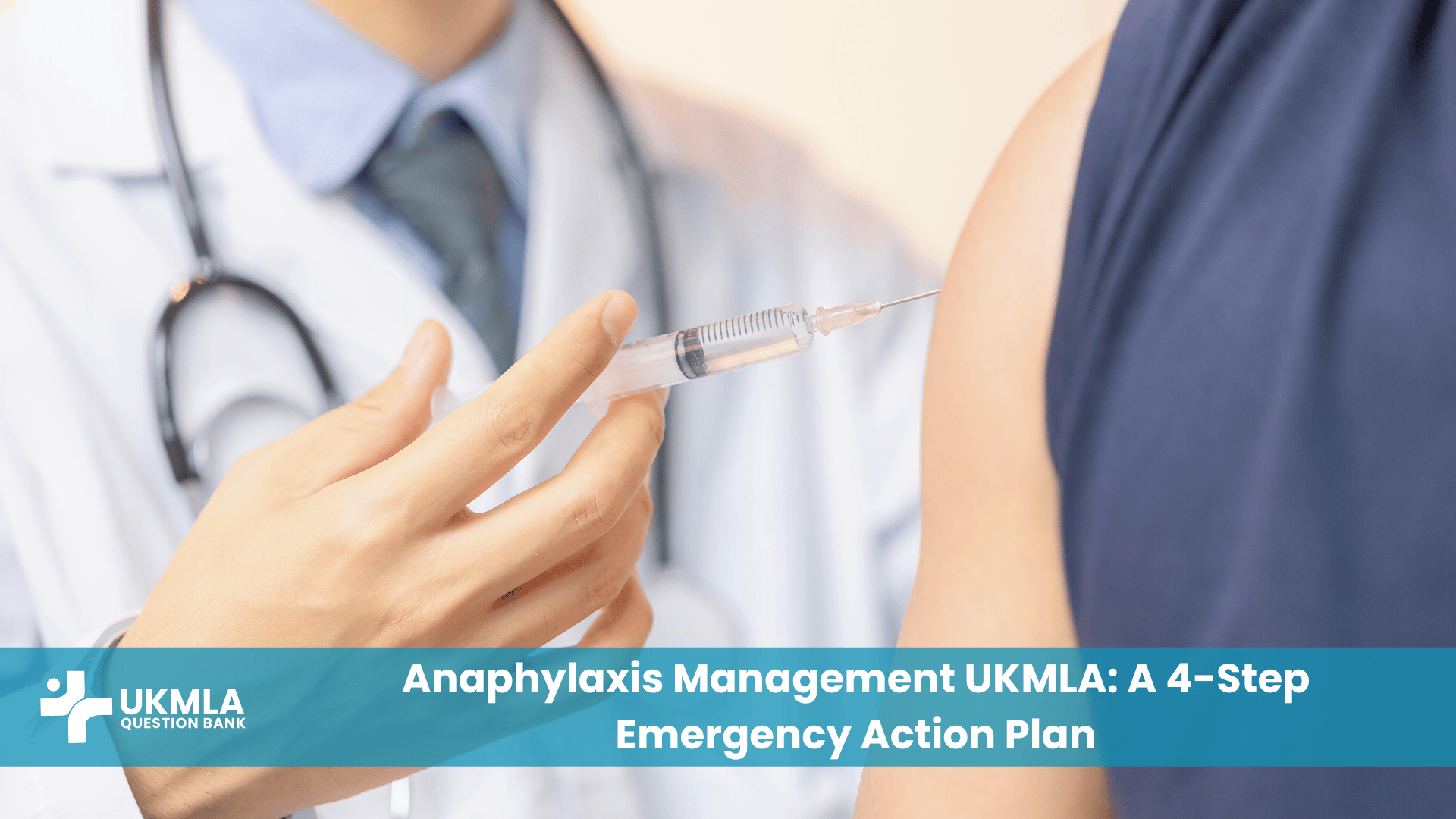
Action: Give Intramuscular (IM) Adrenaline (1:1000 solution) without delay. This is the single most important life-saving step. Adrenaline reverses vasodilation and bronchoconstriction.
Site: Anterolateral aspect of the middle third of the thigh. Can be given through clothing if necessary. Avoid gluteal injection (slower absorption).
Dose: See Table 2. Ensure you know the correct dose for adults and children. Auto-injectors deliver a standard dose (e.g., 300mcg or 500mcg for adults). For drawing up from an ampoule (1mg in 1ml = 1:1000), use a 1ml syringe for accuracy.
Repeat: If no improvement after 5 minutes, repeat the dose.
Table 2: IM Adrenaline Dosing for Anaphylaxis (Adults & Children – RCUK)
| Age | Adrenaline 1:1000 Dose (IM) | Volume (1mg/ml solution) |
|---|---|---|
| Adult & Child > 12 years | 500 micrograms | 0.5 mL |
| Child 6 – 12 years | 300 micrograms | 0.3 mL |
| Child 6 months – < 6 years | 150 micrograms | 0.15 mL |
| Child < 6 months | 100 – 150 micrograms | 0.1 – 0.15 mL |
(Always confirm doses with current official RCUK guidelines)
Step 2: Call for Help & Position the Patient
Action: Shout for help. Call the resuscitation team / activate emergency alert. Anaphylaxis can deteriorate rapidly.
Positioning:
✓ Lie the patient flat.
✓ Elevate their legs (if possible) to aid venous return (unless this compromises breathing).
✓ If breathing is difficult (wheeze, airway swelling), allow them to sit up slightly.
Crucially: Do NOT suddenly sit or stand a patient who feels faint, as this can precipitate cardiovascular collapse (Empty Ventricle Syndrome).
Step 3: Implement the ABCDE Approach
Action: Systematically assess and manage life threats concurrently with adrenaline administration.
Airway: Check for patency. Look for stridor, hoarseness, angioedema. Use basic airway manoeuvres. Consider early senior help (anaesthetics) for definitive airway if compromised.
Breathing: Assess RR, SpO2, work of breathing, chest auscultation (wheeze). Give high-flow oxygen (15L via non-rebreathe mask). Consider nebulised salbutamol for wheeze.
Circulation: Assess pulse, BP, CRT, skin temperature. Establish IV access (x2 large bore). Give rapid IV fluid bolus (e.g., 500-1000ml crystalloid in adults) if hypotensive. Monitor ECG. Consider IV adrenaline infusion in refractory shock (senior/critical care input essential). Consider management in relation to other conditions, e.g. Cardiology Essentials.
Disability: Assess GCS or AVPU. Check blood glucose.
Exposure: Look for skin signs (urticaria, flushing, angioedema), check temperature.
Step 4: Adjunctive Treatments & Monitoring
Action: These are second-line treatments, given after adrenaline and ABCDE stabilisation. They treat symptoms but do not reverse life-threatening features.
Antihistamines: Chlorphenamine (IV/IM). Helps relieve itching and urticaria.
Corticosteroids: Hydrocortisone (IV/IM). May help prevent protracted or biphasic reactions (theoretical benefit, evidence limited).
Monitoring: Continuous monitoring of vital signs (HR, BP, RR, SpO2, GCS) is essential.
Post-Anaphylaxis Management and Discharge Planning
Management doesn’t stop after the initial emergency.
Observation Period
Risk of Biphasic Reaction: Symptoms can recur hours later (typically within 8-12 hours, but can be longer) without re-exposure.
Minimum Observation: All patients should be observed in a clinical setting for at least 4-6 hours after symptoms have resolved. Longer observation (e.g., 12 hours or admission) is needed for severe, protracted, or refractory reactions, those with asthma, or those presenting late.
Identifying the Trigger & Specialist Referral
History: Take a detailed history to try and identify the likely allergen.
Referral: All patients experiencing anaphylaxis should be referred to a specialist allergy clinic for formal investigation (e.g., skin prick testing, specific IgE blood tests) and ongoing management.
Prescribing Adrenaline Auto-Injectors (AAIs) & Patient Education
Prescription: Patients at ongoing risk should be prescribed two adrenaline auto-injectors (AAIs) – e.g., EpiPen, Jext, Emerade.
Education: Crucial component. Patients (and family/carers) must be taught:
✓ How and when to use the AAI (practice with trainer devices).
✓ Allergen avoidance strategies.
✓ Recognising early symptoms.
✓ Carrying their AAIs at all times.
✓ Calling 999 immediately after using the AAI.
Ensure competence in AAI use, linking to principles of Prescribing Safely.
Concise AAI Instruction Aid:
“Remember: Blue to the sky, Orange to the thigh. Pull off the blue safety cap. Swing and firmly jab the orange tip into the outer thigh until it clicks. Hold for 3-10 seconds (check device instructions). Call 999 immediately.”
Reporting
If anaphylaxis was caused by a medication or vaccine, submit a Yellow Card report to the MHRA (Medicines and Healthcare products Regulatory Agency).
Putting It All Together: 2 UKMLA-Style Clinical Scenarios
Case 1: The Patient with Peanut Allergy After Eating Out
Vignette: A 20-year-old known peanut allergy sufferer presents to A&E 15 minutes after eating takeaway. They feel their throat tightening, sound hoarse, and have widespread urticaria. RR 24, SpO2 95% RA, HR 120, BP 100/60.
Immediate Action:
Adrenaline: Give IM Adrenaline 500mcg (0.5ml 1:1000) into anterolateral thigh immediately.
Help/Position: Call resus team, lie patient flat (or allow to sit up slightly due to throat tightness).
ABCDE: High flow O2. IV access, prepare fluids. Assess airway closely (for stridor/swelling). Monitor obs continuously.
Adjuncts: Give IV/IM Chlorphenamine and Hydrocortisone.
Key Learning: Recognise airway compromise. Adrenaline first. Follow with ABCDE and adjuncts. Plan for observation and allergy referral.
Case 2: The Inpatient Who Develops Anaphylaxis After IV Antibiotics
Vignette: A 60-year-old inpatient receives their first dose of IV Co-amoxiclav for pneumonia. 5 minutes later, they complain of feeling unwell, become flushed, short of breath with audible wheeze, and their BP drops to 80/40 mmHg.
Immediate Action:
STOP Infusion: Immediately stop the antibiotic infusion.
Adrenaline: Give IM Adrenaline 500mcg (0.5ml 1:1000) into anterolateral thigh.
Help/Position: Call resus team (2222), lie patient flat, elevate legs.
ABCDE: High flow O2. Secure IV access (if not already present), give rapid IV fluid bolus (500-1000ml crystalloid). Consider nebulised salbutamol for wheeze. Monitor ECG.
Adjuncts: Give IV/IM Chlorphenamine and Hydrocortisone.
Key Learning: Drug allergy is a common cause. Stop the trigger. Adrenaline, ABCDE (especially fluid resuscitation for hypotension). Document allergy status clearly. Report via Yellow Card.
Frequently Asked Questions (FAQ) about Anaphylaxis Management
The correct dose for an adult (and child >12 years) is 500 micrograms of adrenaline (epinephrine) 1:1000 solution, given intramuscularly into the anterolateral thigh. This corresponds to 0.5 mL of the standard 1mg/mL (1:1000) ampoule. Repeat after 5 minutes if no improvement.
Intravenous (IV) adrenaline should only be administered by experienced practitioners in controlled settings (like ICU or experienced anaesthetists/emergency physicians) where continuous cardiovascular monitoring is available. IV adrenaline carries a significant risk of inducing life-threatening tachyarrhythmias or severe hypertension if given incorrectly (wrong dose/rate). Intramuscular (IM) injection is the recommended route for first-line treatment by first responders and most healthcare professionals.
IM injection into the anterolateral thigh provides rapid and reliable absorption into the circulation. Subcutaneous injection results in slower, less predictable absorption, especially if the patient is hypotensive with poor peripheral perfusion. The IV route carries significant risks if not administered carefully by experts.
Adrenaline acts on alpha and beta-adrenergic receptors. Its key life-saving effects in anaphylaxis are:
Alpha-1 agonist: Causes vasoconstriction, reversing peripheral vasodilation, reducing oedema (angioedema), and increasing blood pressure.
Beta-1 agonist: Increases heart rate and contractility, improving cardiac output.
Beta-2 agonist: Causes bronchodilation, relieving wheeze and respiratory distress. It also helps stabilise mast cells, reducing further mediator release.
All patients should be observed for a minimum of 4 to 6 hours after symptoms have completely resolved, due to the risk of a biphasic reaction (recurrence of symptoms without re-exposure). Longer observation (e.g., 12-24 hours or admission) is recommended for patients who had a severe or protracted initial reaction, required repeated adrenaline doses, have significant co-morbidities (especially asthma), or live alone/remotely.
No. While commonly used, antihistamines (like Chlorphenamine) and corticosteroids (like Hydrocortisone) are adjunctive (second-line) treatments. They do not treat the life-threatening airway, breathing, or circulation problems of anaphylaxis and should never delay the administration of adrenaline. Adrenaline is the only first-line, life-saving medication. Antihistamines help with skin symptoms (itch, urticaria), and steroids may potentially reduce the risk or severity of protracted/biphasic reactions.
A biphasic reaction is the recurrence of anaphylactic symptoms hours after the initial reaction has resolved, without any further exposure to the trigger. It occurs in a minority of cases (estimates vary, perhaps up to 20%), typically within 8-12 hours but sometimes later. This is the main reason why a period of observation is necessary after initial treatment.
AAIs should be prescribed to patients considered at ongoing risk of anaphylaxis after assessment by an allergy specialist. This typically includes individuals who have had anaphylaxis triggered by foods, insect stings, or idiopathic causes where future exposure is possible. It’s crucial they are prescribed two devices and receive comprehensive training on how and when to use them, alongside an emergency action plan.
Key discharge advice includes:
Strict avoidance of the identified or suspected trigger.
Understanding the signs and symptoms of anaphylaxis.
Knowing how and when to use their prescribed AAIs (if applicable), and always carrying two.
Calling 999 immediately after using an AAI.
Importance of attending follow-up with an allergy specialist.
Wearing medical alert jewellery if appropriate.
The definitive UK guidelines are published by the Resuscitation Council UK. Their “Emergency treatment of anaphylactic reactions” guideline provides detailed algorithms, drug dosages, and management principles for healthcare professionals.
Conclusion
Effective anaphylaxis management UKMLA requires rapid recognition, immediate administration of IM adrenaline, and a systematic ABCDE approach to address life threats. Remembering the 4 key steps – Adrenaline, Help & Position, ABCDE, Adjuncts – provides a clear framework for this medical emergency. Post-reaction care, including observation, specialist referral, and patient education (especially regarding AAIs), is equally vital to prevent future episodes.
Familiarity with the Resuscitation Council UK guidelines and practice through simulation will build the competence and confidence needed to manage anaphylaxis safely and effectively, both for the UKMLA and throughout your clinical career.
Your Next Steps
Memorise the 4 Steps: Commit the Adrenaline -> Help/Position -> ABCDE -> Adjuncts sequence to memory.
Know Adrenaline Doses: Learn the correct IM adrenaline doses for adults and different paediatric age groups (Table 2).
Practice Recognition: Review the diagnostic criteria and differentiate anaphylaxis from faints. Look for Red Flag Symptoms of ABC compromise.
Understand AAI Use: Learn the steps for using common adrenaline auto-injectors – a key Procedural Skill concept.
Review Guidelines: Bookmark and familiarise yourself with the Resuscitation Council UK anaphylaxis guidance.
Consider Pharmacology: Understand the actions of adrenaline and adjuncts like antihistamines and steroids, covered in High Yield Pharmacology.