
Introduction
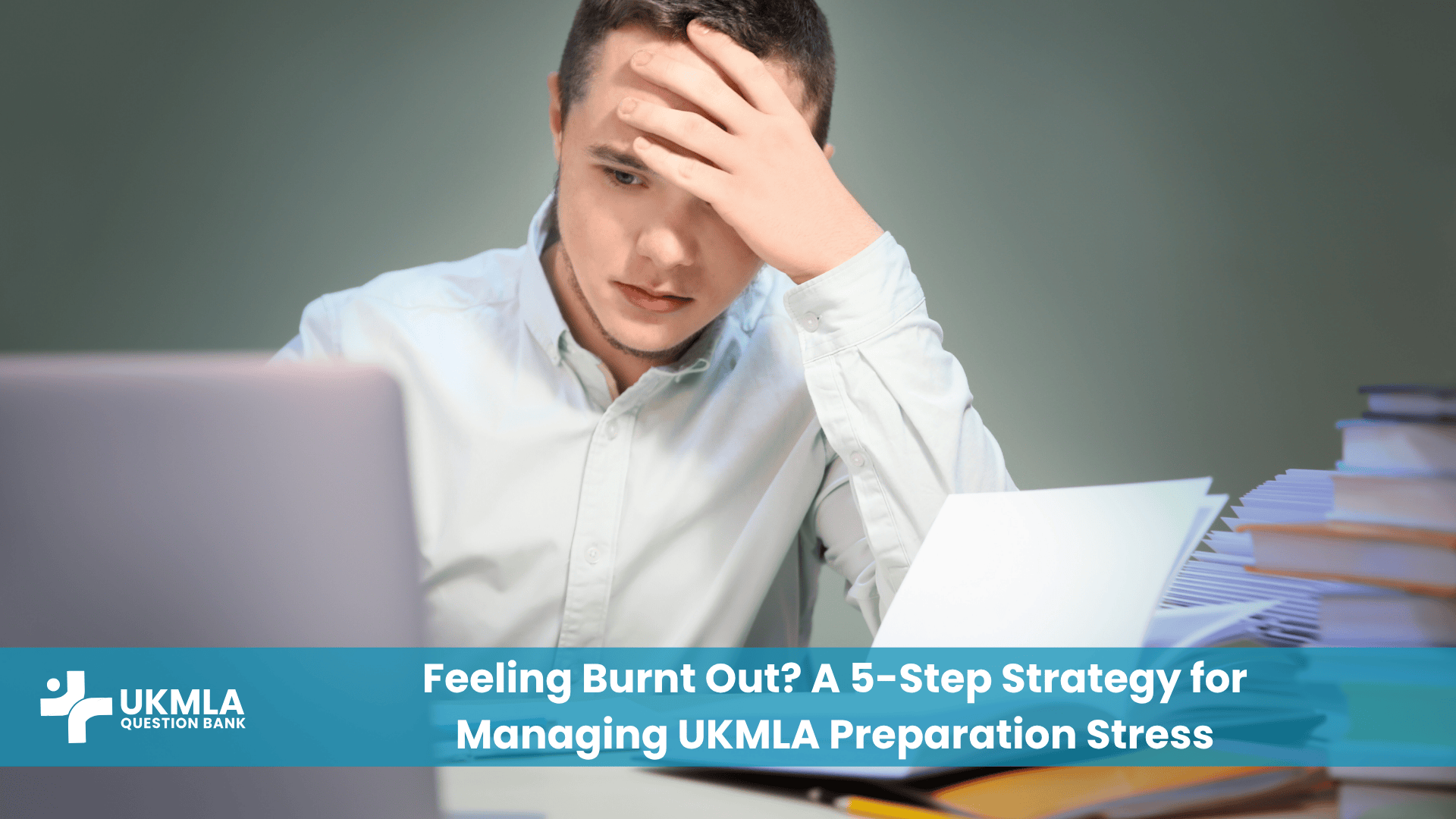
It’s more than just “exam stress.” It’s a bone-deep emotional, physical, and mental exhaustion. You feel detached from your work, your revision is ineffective, and the very motivation that got you into medicine feels like it’s gone. This is burnout during UKMLA preparation, and it’s a real and serious obstacle that can derail your revision and harm your well-being.
This is not a sign of failure or weakness; it is an occupational hazard of a high-pressure field. You cannot “just push through” it. This 5-step strategy is a practical, active recovery plan. It’s not just about “relaxing” for a day; it’s about fundamentally rebuilding your approach to revision and protecting your mental health for a long-term career.
Table of Contents
ToggleKey Takeaways
Burnout is Not Just Stress: Burnout is a specific state of exhaustion, cynicism (detachment), and a feeling of reduced efficacy.
Recognizing It is the First Step: The 5-step strategy begins with having the courage to acknowledge the problem and stop, rather than “pushing through.”
“Smarter, Not Harder” is the Cure: Burnout is often a symptom of an unsustainable or inefficient study system. Active recovery involves rebuilding a smarter one.
This is a Professional Skill: Managing your own well-being is a core professional duty and essential for a sustainable career.
Why You Can’t “Just Push Through” Burnout
Burnout is a state of chronic, unmanaged stress that leads to three core symptoms. Unlike simple stress, which can be motivating, burnout is a state of depletion.
What is Burnout? (Exhaustion, Cynicism, Inefficacy)
Exhaustion: Deep mental and physical fatigue. You feel drained every morning, even after sleeping.
Cynicism / Detachment: You feel disconnected from your studies and future career. You may feel cynical about the exam or medicine itself, thinking, “What’s the point?”
Reduced Efficacy: You’re putting in the hours, but nothing is going in. You feel ineffective, which makes you study more, which worsens the exhaustion. This is the “burnout loop.”
Table 1: Recognizing Burnout vs. Stress
| Symptom | Normal Stress | Burnout |
|---|---|---|
| Emotions | Anxiety, pressure, a feeling of urgency. Can be motivating. | Emptiness, detachment, cynicism, dread, loss of motivation. |
| Productivity | Often high (e.g., “cramming”). You are “hyper-engaged.” | Very low, despite long hours. You are “disengaged.” |
| Outlook | “I can do this if I just get through this week.” | “I don’t care anymore” or “I can’t do this, no matter what.” |
Your Professional Duty to Your Own Health
The GMC is clear that managing your own health is a professional requirement. You cannot care for others if you are unwell.
“You must protect patients from any risk posed by your health. If you know that you have, or think that you might have, a condition that could affect your performance or judgement… you must take and follow advice from a healthcare professional on whether you should modify, limit or stop your practice.”
How Burnout Wrecks Your Revision
Burnout is the enemy of effective learning. It destroys your ability to do deep work and retain information. It is also a direct cause of the kind of panic and mental freezing seen in UKMLA exam anxiety. You’re not just tired; your brain is in self-preservation mode.
The 5-Step Strategy to Recover from UKMLA Burnout
This is a guide to recovering from burnout during ukmla preparation. It’s an active process.
Step 1: Acknowledge & Stop (The “Emergency Brake”)
The most important step. You cannot fix burnout by doing more of what caused it. You must stop.
Action: Take a minimum of 48 hours completely off. No question banks, no note-reading, no “quick” revision.
Why: This breaks the cycle. It stops the adrenaline-cortisol loop and gives your brain a chance to start recovering. This is the hardest, most courageous, and most necessary step.
Step 2: Reconnect (With Your “Why” and Your Life)
During your 48-hour break, do not just sit and feel guilty. Actively reconnect with the parts of your life you’ve abandoned.
Reconnect with your body: Go for a long walk, cook a proper meal, sleep without an alarm.
Reconnect with people: See a friend and talk about anything other than the UKMLA.
Reconnect with your “Why”: Remember why you started this. Watch a medical documentary, think about a patient who inspired you. This helps rebuild the mindset for UKMLA success.
Step 3: Rebuild (Study Smarter, Not Harder)
Burnout is often a sign that your study method is broken. You are likely working long, passive, inefficient hours.
Audit your timetable: Your old plan failed. A new, realistic UKMLA revision timetable is essential.
Prioritise “Active > Passive”: Stop just re-reading notes. Switch 80% of your time to active methods.
Use high-yield techniques: Focus on active recall and spaced repetition. A 2-hour active QBank session is worth more than 6 hours of passive highlighting.
Step 4: Protect (Set Boundaries)
Your new schedule must have boundaries, or you will burn out again.
Define “Done for the Day”: Have a hard stop time (e.g., 6 PM).
Schedule “Off” Time: Your timetable must include protected days off. This is non-negotiable.
Protect Your Sleep: A minimum of 7-8 hours. This is where memory consolidation happens.
Step 5: Seek Help (Professional Support)
If you are still struggling after a week, it is time to seek professional help. This is not a failure; it’s a sign of strength and a core professional action.
University/Med School: Speak to your university’s student support services.
BMA: The British Medical Association offers confidential 24/7 counselling.
Your GP: Burnout can mask or trigger other conditions, like depression.
See our “Your Next Steps” section for a direct link to the BMA’s support services.
Putting It into Practice: Actionable Plans
What to Do Today: An Emergency 3-Point Action Plan
If you are reading this and feel you are in acute burnout right now:
Stop. Close your books. Put your notes away. Your study day is over.
Move. Get out of your study environment. Go outside and walk for 30 minutes without your phone.
Talk. Call a friend or family member and tell them you are struggling. Saying it out loud breaks the cycle of isolation.
Table 2: The 5-Step Burnout Recovery Strategy (Summary)
| Step | Action | Purpose |
|---|---|---|
| 1. Acknowledge & Stop | Take a 48-hour (minimum) break from all revision. | Break the stress cycle. Allow your brain and body to rest. |
| 2. Reconnect | Engage in non-medical life: sleep, eat well, see friends. | Restore your identity outside of “medical student.” |
| 3. Rebuild | Create a new, sustainable study plan (fewer hours, more active recall). | Fix the underlying problem: inefficient or unsustainable work. |
| 4. Protect | Set hard boundaries for study times and “off” days. | Make recovery and well-being a non-negotiable part of your plan. |
| 5. Seek Help | Contact your GP, university support, or the BMA. | Recognise that you don’t have to (and shouldn’t) manage this alone. |
Case Studies: What UKMLA Burnout Looks Like
Scenario 1: The “Cynical” Student (Detachment)
Vignette: “Sarah” is 3 months from her exam. She used to be a top student, but now she skips lectures, feels irritable, and finds herself thinking, “Who even cares about this? It’s all a pointless hoop-jumping exercise.” She feels guilty for feeling this way, which makes her withdraw more.
Analysis: This is classic cynicism/detachment. Sarah needs to Stop (Step 1) and Reconnect (Step 2) with her “Why.” She has lost her motivation. Re-engaging with her positive mindset is her first priority.
Scenario 2: The “Exhausted” Student (Ineffective Study)
Vignette: “Ben” is studying 12 hours a day. He re-reads his notes and highlights textbooks, but his QBank scores are stagnant. He’s tired all the time, gets tension headaches, and feels like a failure.
Analysis: This is classic reduced efficacy. Ben’s problem is his method. He needs to Rebuild (Step 3). He must scrap his passive re-reading and build a new, sustainable timetable based on active recall and question banks.
Your Turn: A Self-Assessment Exercise
Task: Read the 5-point checklist below. Be honest. If you tick 3 or more, you are at high risk of burnout, and you should implement the 5-step strategy today.
[ ] Do you feel tired or drained most days, even after sleeping?
[ ] Do you feel detached from your work, cynical, or find it hard to care?
[ ] Are your study hours high but your scores/retention are low?
[ ] Are you neglecting meals, exercise, or hobbies you used to enjoy?
[ ] Do you feel irritable, overwhelmed, or “empty”?
Model Answer / Next Steps: If you ticked 3 or more of these, you are showing the classic signs of burnout. This is your warning sign. Stop. Take a break today. Your priority is not to study more, but to recover. Start with Step 1 and Step 2, and then rebuild a smarter, more sustainable study plan.
Frequently Asked Questions (FAQ) about burnout during ukmla preparation
No. In fact, this is the most critical time to act. “Pushing through” with burnout will lead to a disastrous exam day. Taking a 2-3 day “emergency brake” now to rest and rebuild your strategy (Steps 1, 2 & 3) will make your remaining 3-4 weeks far more productive than 4 weeks of exhausted, ineffective study.
They can overlap significantly, and burnout can trigger a depressive episode. A key difference is the context. Burnout is typically work-related (in this case, your “work” is UKMLA prep). You may feel exhausted and cynical about your revision but still enjoy other parts of your life. Clinical depression tends to be more global, causing a low mood and loss of pleasure in all areas of life. If you suspect depression, you must see your GP.
This is a very difficult social pressure. Be honest and frame it as a strategy, not a failure.
Don’t say: “I can’t cope, I’m giving up.”
Do say: “My current study method isn’t working and is leading to burnout. To perform at my best, I am taking a strategic 2-day break to recover so I can study more efficiently next week. This is a vital part of my plan to pass.”
Burnout is not “all in your head.” It has real physical symptoms caused by chronic stress:
Tension headaches or migraines
Insomnia (tired but wired) or hypersomnia (sleeping all the time)
New or worsening gut issues (IBS, acid reflux)
Increased frequency of getting ill (colds, etc.)
Aches, pains, and extreme muscle fatigue
It could be. A score drop is a key sign of reduced efficacy. If you are studying hard but your scores are going down, it’s a major red flag that your brain is overloaded and no longer retaining information. This is a classic symptom of burnout during ukmla preparation, and a sign to stop and re-evaluate how you are studying.
This is the hardest part. The “guilt” is a symptom of burnout culture. You must reframe the break. A break is not “wasted time”; it is essential recovery time. It is active, scheduled maintenance. A Formula 1 car needs a pit stop to win the race. You need a break to pass the exam.
Active recall. Passive re-reading is a fast track to burnout because it’s low-yield and takes forever. Doing one hour of high-intensity active recall (e.g., question banks, flashcards) is more effective than 4 hours of highlighting. This “smarter, not harder” approach is the ultimate cure. It shortens your study day and gets better results.
Sustainability. Build your revision plan from Day 1 with boundaries.
Time-block: Study in focused 50-minute blocks with 10-minute breaks.
Schedule “Off” Time: Put your free time, exercise, and social life in your calendar first, and schedule your study around them.
Sleep: Make 8 hours of sleep non-negotiable.
Absolutely not. It is a sign that you are a normal human being in an extraordinarily high-pressure system. Burnout is common among the most dedicated and conscientious students and doctors. Learning to manage it now is the single best skill you can develop for a long, healthy career in medicine.
This is the most important question. If you are struggling, please reach out.
Your GP: They are your first, confidential port of call.
BMA: The British Medical Association offers 24/7 confidential counselling and peer support, available to all medical students, whether you are a member or not.
University: Your medical school will have a dedicated student support or well-being officer.
Conclusion
Burnout during UKMLA preparation is a warning sign from your body and mind that your current approach is unsustainable. It is not a personal failure. It is a fixable problem, but it requires you to act differently, not just “try harder.”
By using this 5-step strategy, you can move from a state of exhaustion to one of active, efficient, and sustainable preparation. Learning to manage your own well-being is the first and most important professional skill you will ever master. It is the foundation not just for passing the UKMLA, but for a long, successful, and healthy career in medicine.
Your Next Steps
Be Honest: Do the self-assessment exercise. If you are at risk, start Step 1 today.
Rebuild Your Timetable: Ditch the 12-hour passive study days. Build a new, sustainable plan based on active recall.
Seek Support: Do not do this alone. Talk to a friend, your family, or your university.
Use Professional Services: If you are struggling, please use the confidential BMA counselling and peer support service. It’s free, confidential, and run by people who understand.