
Introduction
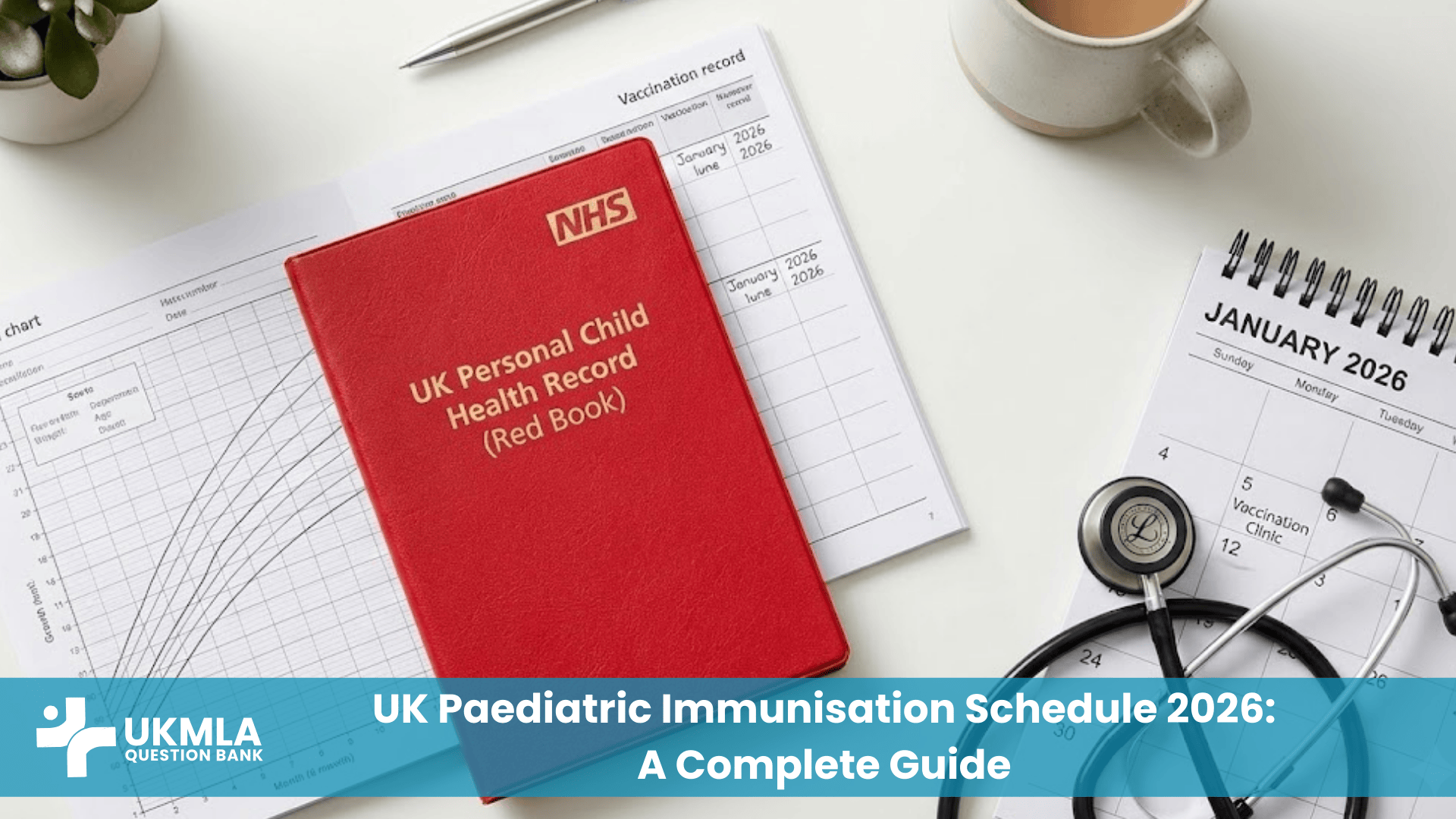
The uk paediatric immunisation schedule 2026 represents the most significant shift in British public health policy in over a decade. As of January 1, 2026, the National Health Service (NHS) has fundamentally restructured the early years timeline, introducing routine protection against Chickenpox (Varicella) and establishing a new dedicated appointment at 18 months.
For the medical student or junior doctor preparing for the UKMLA, this update renders many of your old revision notes obsolete. The classic mnemonics regarding the “1-year immunisations” or the components of the “Pre-school booster” have changed. In the Applied Knowledge Test (AKT), you will be tested on the current guidelines found in the official GOV.UK Routine Immunisation Schedule, not the historical ones. A failure to recognize the new timing for the second dose of MMRV or the discontinued MenC booster could cost you vital marks.
This guide is designed to be your definitive reference. We will break down the new 2026 timeline step-by-step, explain the clinical reasoning behind the MMRV introduction, and provide the specific “catch-up” algorithms you need for the Clinical and Professional Skills Assessment (CPSA).
Table of Contents
ToggleKey Takeaways
MMRV is Here: The separate MMR vaccine has been replaced by the combined MMRV (Measles, Mumps, Rubella, Varicella) vaccine for routine appointments.
The 18-Month Check: A new routine immunisation appointment has been introduced at 18 months of age to deliver the second dose of MMRV and the 4th dose of the 6-in-1 (Hexavalent).
MenC Gone: The separate Hib/MenC booster previously given at 1 year has been discontinued. Protection against Hib is now boosted at 18 months via the Hexavalent vaccine.
Timing Shifts: Remember that MenB dose 2 is now routinely given at 12 weeks (not 16 weeks), and PCV dose 1 is at 16 weeks (not 12 weeks), changes that were finalized in late 2025.
Catch-Up Rules: Children born before the rollout dates have specific “catch-up” criteria for Varicella; it is not automatically retroactive for all older children.
The 2026 Routine Schedule (The “Gold Standard”)
This is the definitive timeline you must commit to memory for the UKMLA. The primary changes focus on the 12-month to 3-year, 4-month period.
UKMLA Note: The 6-in-1 vaccine protects against Diphtheria, Tetanus, Pertussis (Whooping Cough), Polio, Hib (Haemophilus influenzae type b), and Hepatitis B.
| Age | Vaccine(s) | Diseases Protected Against |
|---|---|---|
| 8 Weeks | 6-in-1 (Dose 1) Rotavirus (Oral) MenB (Dose 1) |
Diphtheria, Tetanus, Pertussis, Polio, Hib, HepB Rotavirus gastroenteritis Meningococcal Group B |
| 12 Weeks | 6-in-1 (Dose 2) Rotavirus (Oral) MenB (Dose 2) |
As above (MenB timing changed in 2025). |
| 16 Weeks | 6-in-1 (Dose 3) PCV (Dose 1) |
Pneumococcal Disease (13 serotypes). |
| 1 Year | MMRV (Dose 1) MenB (Booster) PCV (Booster) |
Measles, Mumps, Rubella, Varicella (Chickenpox) MenB, Pneumococcal. |
| 18 Months | MMRV (Dose 2) 6-in-1 (Dose 4) |
Full protection against MMR/Chickenpox. Booster for Hib/HepB/Polio/Tetanus/Diphtheria. |
| 3 Years 4 Months | 4-in-1 (Pre-school Booster) | Diphtheria, Tetanus, Pertussis, Polio. (Note: MMR is no longer given here routinely). |
| 12-13 Years | HPV (1 Dose) | Human Papillomavirus (Cervical/Anal/Head & Neck cancers). |
| 14 Years | 3-in-1 (Teenage Booster) MenACWY |
Tetanus, Diphtheria, Polio Meningococcal Groups A, C, W, Y. |
The Major Change: MMRV (Chickenpox) Vaccine
The introduction of the MMRV vaccine is the headline news of the 2026 schedule. It replaces the standalone MMR vaccine for routine appointments.
Why the Change?
Historically, the UK did not vaccinate against Chickenpox (Varicella Zoster) because of concerns about shifting the disease to older age groups (where it is more severe) and potentially increasing Shingles rates in the elderly (due to a lack of natural boosting).
However, updated JCVI modelling showed that:
Complications are significant: Chickenpox is a leading cause of severe bacterial superinfection (Group A Strep) in children. You must be able to differentiate these presentations from vaccine reactions—see our guide on Common Paediatric Rashes for high-quality clinical images.
Two-dose strategy works: By giving doses at 12 months and 18 months, herd immunity is achieved rapidly, protecting those who cannot be vaccinated.
School attendance: Reducing chickenpox outbreaks significantly reduces school absences and parental time off work.
The “Cohort” Confusion
For the UKMLA, you must know which child gets which vaccine.
Born on/after 1st Jan 2025: Will receive the full new schedule (MMRV at 12m and 18m).
Born before 2025: These children are currently in a “Catch-up Campaign” phase. If they present to your GP practice aged 3-6 years old having missed Chickenpox immunity, they are eligible for a catch-up dose, often given alongside the pre-school booster.
The New 18-Month Appointment
Prior to 2026, there was a long gap between the “1-year immunisations” and the “Pre-school booster” at 3 years and 4 months. This gap often led to a drop-off in compliance.
The new 18-Month Check serves three purposes:
MMRV Dose 2: Completes protection against Measles and Chickenpox early, before the child enters nursery/preschool mixing circles.
Hexavalent (6-in-1) Dose 4: This acts as a booster for Hib (Haemophilus influenzae type b) and Hepatitis B.
Developmental Opportunity: It provides a formal touchpoint for Health Visitors or GPs to assess Paediatrics Essentials (e.g., walking, early speech) which was previously unstructured.
Note: Because the Hexavalent booster is now given at 18 months, the old Hib/MenC (Menitorix) vaccine at 12 months has been discontinued. Meningitis C protection is now primarily relied upon via the adolescent Men ACWY vaccine and herd immunity.
Changes You Might Have Missed (July 2025 Updates)
While the MMRV is the 2026 headline, two subtle timing changes from late 2025 are still tripping up candidates.
MenB (Meningococcal B)
Old Schedule: 8 weeks, 16 weeks, 1 year.
New Schedule: 8 weeks, 12 weeks, 1 year.
Reasoning: Moving the second dose to 12 weeks provides earlier protection during the peak risk window for infants.
PCV (Pneumococcal)
Old Schedule: 12 weeks, 1 year.
New Schedule: 16 weeks, 1 year.
Reasoning: This spacing allows for co-administration with other vaccines at 16 weeks and reduces the number of separate appointment visits required (improving attendance).
Special Risk Groups
While the routine schedule covers 99% of children, the UKMLA tests the exceptions.
Hepatitis B (Selective Pathway)
Infants born to Hepatitis B positive mothers (HBsAg positive) are high risk for vertical transmission and chronic carriage. They follow a specific, intensified pathway outlined in General Practice Essentials.
Birth: Monovalent HepB vaccine + HBIG (Immunoglobulin) (if mother is highly infectious/e-antigen positive).
4 Weeks: Monovalent HepB vaccine.
8 Weeks: Routine 6-in-1 (contains HepB).
12 Weeks: Routine 6-in-1.
16 Weeks: Routine 6-in-1.
1 Year: Blood test for HBsAg (to check for infection).
18 Months: Routine 6-in-1 booster.
BCG (Tuberculosis)
The UK does not vaccinate everyone for TB. It is risk-based.
Indication: Infants born in areas of the UK with TB incidence >40 per 100,000 OR infants with a parent/grandparent born in a high-prevalence country.
Timing: Usually at birth (or as soon as possible).
Contraindications & Cautions
Understanding when not to vaccinate is a key skill covered in our Anaphylaxis Management guide.
Anaphylaxis
The only absolute contraindication to a vaccine is a confirmed anaphylactic reaction to a previous dose of that vaccine or one of its components (e.g., Neomycin or Gelatine).
Egg Allergy
MMR/MMRV: Safe. The virus is grown on fibroblast cells, not egg. Even if there is a trace, it is safe for children with egg allergy (including anaphylaxis) to be vaccinated in primary care.
Influenza (Flu): Most injectables are egg-free. The nasal spray has trace egg protein but is safe for those with mild allergy. Those with egg anaphylaxis should receive an egg-free injectable.
Immunosuppression
Live Vaccines contain weakened virus and pose a risk to severely immunosuppressed children (e.g., SCID, Chemotherapy, High-dose steroids).
The Live Vaccines in 2026:
Rotavirus (Oral).
MMRV (Injectable).
BCG (Intradermal).
Flu Nasal Spray.
Action: Do not administer these without specialist advice. Inactivated vaccines (6-in-1, MenB) are safe but may be less effective.
Clinical Scenarios: Putting it into Practice
Scenario 1: The “Anti-Vax” Discussion
Parent: “I’ve heard the MMRV overloads the immune system because it’s too many viruses at once.” Doctor’s Response: You must acknowledge the concern but correct the science. Utilizing principles from Informed Consent Guidelines is crucial here.
Fact: A baby’s immune system fights thousands of antigens daily (from crawling on the floor, eating, breathing).
Fact: The vaccines contain only a tiny handful of protein markers (antigens).
Fact: Combined vaccines (like MMRV) reduce the number of injections (distress) and provide protection sooner. Delaying “to split them up” leaves the child vulnerable to Measles and Chickenpox during the delay.
Scenario 2: The Immigrant Child
Patient: A 4-year-old arrives from a country with a different schedule. They have no documentation. Action: The UKHSA rule is: “If in doubt, immunise.”
You cannot assume they are protected.
Start the Vaccination of Individuals with Uncertain or Incomplete Immunisation Status algorithm.
For a 4-year-old in 2026: They need a dose of MMRV, a dose of the Pre-school booster (4-in-1), and likely catch-up doses of MenB depending on the specific algorithm.
Practice Exercise: Test Your Knowledge
Question 1: A 4-month-old baby presents for their routine immunisations. Which vaccines are they due to receive today under the 2026 schedule?
A) 6-in-1 + PCV + MenB
B) 6-in-1 + Rotavirus + MenB
C) 6-in-1 + PCV
D) 6-in-1 + Rotavirus
E) MMRV + MenB
Correct Answer: C (6-in-1 + PCV). At 16 weeks (4 months), the schedule is the 3rd dose of the 6-in-1 and the 1st dose of PCV. Note that Rotavirus is given at 8 and 12 weeks only (it is contraindicated after 24 weeks due to intussusception risk).
Question 2: A mother brings her 13-month-old son. He received his 1-year immunisations last week (MMRV, MenB, PCV). She is worried he has a fever of 38.5°C today and a mild rash. What is the most appropriate advice?
A) Urgent referral to Paediatrics for suspected Meningitis.
B) Reassurance and Paracetamol; this is a common reaction to the MMRV component.
C) Reassurance; this is a common reaction to the MenB component.
D) Prescribe oral antibiotics for suspected otitis media.
E) Report as a Yellow Card adverse event immediately.
Correct Answer: B. While MenB causes fever within 24-48 hours, the MMR/MMRV vaccine typically causes a fever and/or a mild measles-like rash 6 to 10 days after administration. This fits the timeline perfectly (1 week later).
Frequently Asked Questions (FAQ) about the UK Paediatric Immunisation Schedule 2026
Yes, the MMRV vaccine (typically Priorix-Tetra or ProQuad) usually contains hydrolysed gelatine derived from pork as a stabiliser. This is a common concern for Muslim and Jewish parents. However, many religious leaders have ruled that it is permissible (halal/kosher) because the gelatine is chemically transformed and the purpose is saving life. If parents absolutely refuse, separate vaccines may be sourced, but the single Varicella vaccine may also contain gelatine.
The Hib/MenC booster (Menitorix) was stopped because the success of the MenC vaccination programme meant there was virtually no circulating Meningitis C disease in infants. The focus shifted to reinforcing protection against Hib (which was showing signs of waning) via the 18-month Hexavalent booster.
Yes, but specifically for the MenB vaccine. NICE guidelines recommend giving prophylactic liquid paracetamol at the time of the MenB vaccination (8 weeks and 1 year) and two further doses at 4-6 hour intervals. This reduces the risk of high fever and febrile convulsions. It is not routinely required for other vaccines unless fever develops.
The Rotavirus vaccine is an oral liquid. If the infant spits it out or vomits immediately, do not repeat the dose. It is a live vaccine, and repeating it risks overdose or unnecessary exposure. Even a partial dose provides some protection.
Yes. Premature babies should be immunised according to their chronological age (time since birth), not their corrected age. They need the protection even more. The only difference is that if they are still in the hospital (NICU), they should be monitored for apnoea/bradycardia for 48 hours post-vaccination.
Yes. There is no harm in vaccinating a child who has had natural chickenpox; it simply acts as a booster. Furthermore, unless the diagnosis was confirmed by a blood test, “parent-reported” chickenpox is often incorrect (it could have been viral exanthem or hand, foot, and mouth). It is safer to give the MMRV to ensure full Measles/Mumps/Rubella protection.
Yes, private vaccination is available for older children who fall outside the “catch-up” cohorts. However, the NHS catch-up campaign is quite broad (covering most under-6s), so check eligibility by referencing the NHS Vaccinations Guide before paying.
Vaccination in the UK is not mandatory by law (unlike some countries). However, it is highly recommended. The 18-month check is a vital safety net. If a parent refuses, you must document a discussion about the risks of leaving the child unprotected against Measles and Hib.
Yes. A minor illness without fever (snuffles, cough) is not a contraindication. If the child has a significant fever (febrile) or is systemically unwell, vaccination should be postponed until they have recovered to avoid confusing vaccine side effects with the illness.
For infants under 1 year, injections are usually given in the anterolateral thigh (vastus lateralis). For children over 1 year (who are walking), the deltoid muscle (upper arm) is preferred.
Conclusion
The uk paediatric immunisation schedule 2026 is designed to provide broader protection (adding Chickenpox) and smarter timing (the 18-month check). For the UKMLA, success comes from attention to detail.
Remember the Big Three Changes:
MMRV replaces MMR at 1 year and 18 months.
6-in-1 has a 4th dose at 18 months.
MenB dose 2 is at 12 weeks.
Your Next Steps
Print the Table: Stick the new 2026 schedule on your wall.
Practice the “Transition”: Create a scenario for a child born in 2024 vs 2025 and map out their different vaccine dates.
Review Anaphylaxis: Ensure you know the dose of Adrenaline (IM 1:1000) for an infant (150 micrograms / 0.15ml) versus a child (300 micrograms / 0.3ml).